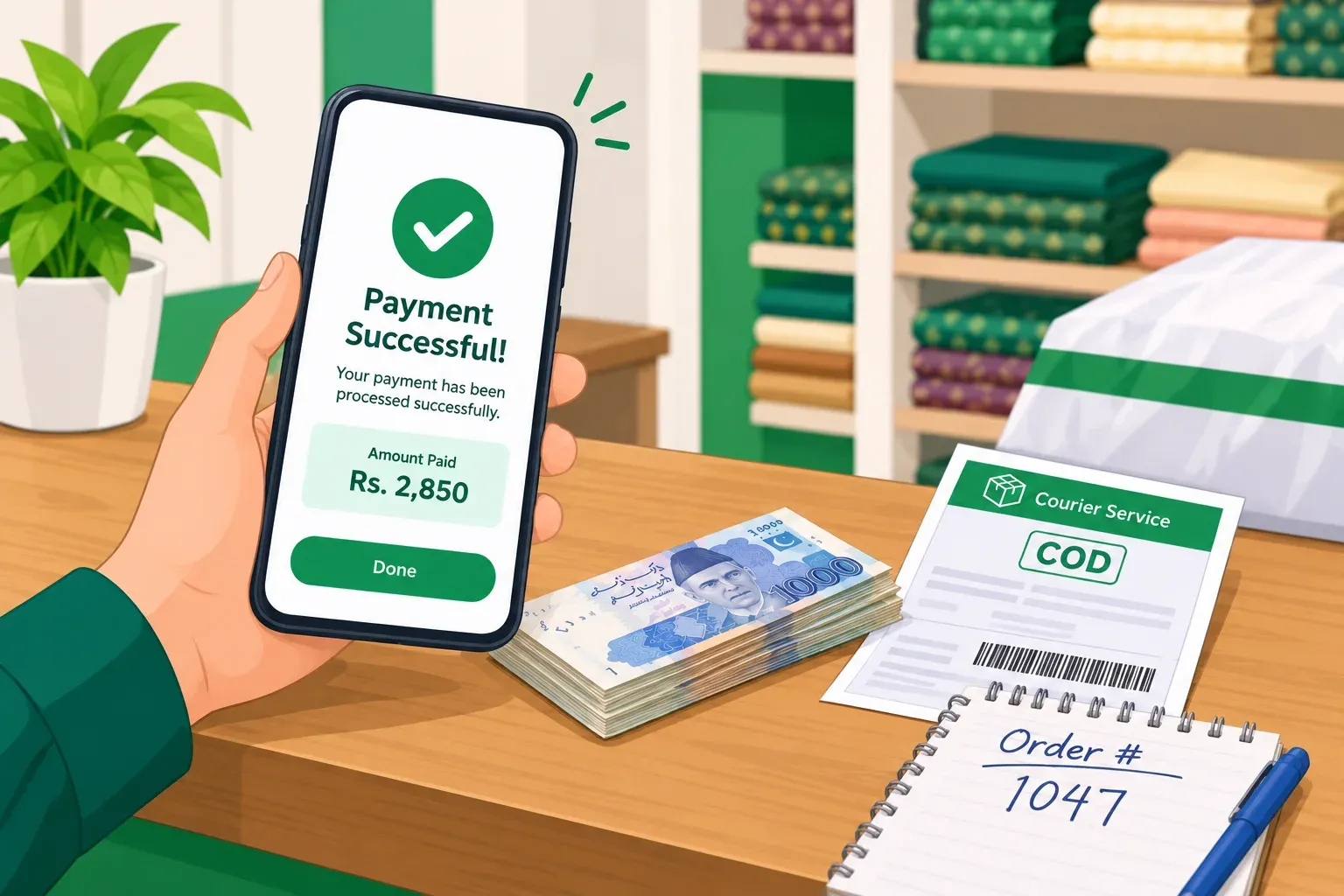
Offer all four. Cash on delivery wins the first order from a customer who does not trust you yet; JazzCash and Easypaisa win the prepaid orders that never come back as returns; and a bank account with a Raast ID handles larger payments and customers who do not use wallets. Each method covers a gap the others leave, and the shops that grow make prepaid slightly more attractive without ever making COD feel like a penalty.
Why does the choice of payment methods matter so much in Pakistan?
Because in Pakistan the payment method decides whether the parcel comes back. A COD order can be refused at the door; a prepaid order cannot. DHL’s guidance for Pakistani e-commerce sellers, citing TGM Research, says nearly 70% of Pakistani online shoppers prefer cash on delivery, and puts the national COD return rate at roughly 18 to 20%. Every order you move from COD to prepaid is an order that cannot be refused and a courier fee you will not pay twice.
At the same time, digital payment is no longer a niche. The State Bank of Pakistan’s FY25 payment systems review reports that account and wallet-based channels now represent 93% of online payment transactions, and that e-money wallet transactions roughly doubled during the year. The customers who are willing to prepay exist in large numbers; the question is whether your checkout makes it easy for them.
So the payment mix is not a technical setting. It is a lever on your return rate, your cash flow and your customer trust, and it deserves a deliberate decision.
What does each payment method do well and badly?
Each method has a job it does better than the others and a cost the others do not have. Here is the honest version of all four.
Cash on delivery
The customer pays the courier rider in cash when the parcel arrives, and the courier remits the money to you later, minus delivery and a COD handling fee. It is the method most first-time buyers insist on, because they do not yet trust a shop they found on Instagram, and it needs no account, card or app on the customer’s side. The costs are the refusal risk, the COD fee, the wait for remittance, usually weekly, and the fake orders that only COD attracts. Our guide to cash on delivery in Pakistan covers fake orders and returns in detail.
JazzCash
A mobile wallet that most Pakistani phone users already have or can open with a CNIC in minutes. For the seller, a JazzCash number on the order page or catalogue lets a customer pay in seconds from their phone, and the money arrives immediately. The limits are the customer’s wallet balance and daily transfer caps, the fees your account tier may charge, and the manual work of matching a screenshot to an order if you have no merchant integration.
Easypaisa
The other large mobile wallet, with the same strengths and limits. Many customers have one wallet and not the other, which is why you offer both. Easypaisa to Easypaisa and JazzCash to JazzCash transfers are the paths of least resistance for customers; cross-wallet or bank-to-wallet transfers add friction and sometimes fees on the customer’s side.
Bank transfer and Raast
A bank account reaches customers who do not use wallets and handles amounts above wallet limits, which matters for bridal orders, furniture and bulk. Raast, the State Bank’s instant payment system, makes this easier: per the SBP’s Raast FAQs, a Raast ID is “a simple identifier (currently mobile number) that you link with your bank account”, so customers can pay your mobile number instead of typing an IBAN, and the SBP states that “currently there are no charges on RAAST transactions.” The limits are that some customers’ banks are slower to adopt it, that you still need to match a transfer to an order, and that the customer must already have a bank account.
Card payments through a gateway are a fifth option, but for most small shops they add cost and setup for a small share of customers; add them later if you sell to card-paying buyers abroad or in the big cities.
Which payment methods should a small shop offer?
All four, presented in the right order, with COD as the visible default and prepaid as the rewarded option. Here is the setup that works for most shops.
- COD, always available, and shown first. It is what wins a stranger’s first order.
- JazzCash and Easypaisa, both, with the number clearly shown and a one-line instruction: pay, screenshot, send on WhatsApp with your order number.
- A bank account with a Raast ID registered to your business number, for larger orders and for customers who do not use wallets.
- A small reward for prepaid: free delivery, a modest discount, or priority dispatch. Never a surcharge on COD; a visible COD charge reads as a penalty and loses orders.
- A token advance required on custom, high-value or bulk orders, paid by any of the prepaid methods. This is where fake COD orders disappear.
Over a few months, the share of prepaid orders rises on its own, because repeat customers who trust you take the reward, and new customers who do not still have COD. Our guide on how to price products for online selling shows how to build the COD fee into the base price so the prepaid reward does not cost you margin.
How do you handle prepaid payments without losing track?
Match every payment to an order the same day, by a fixed routine, or prepaid will cost you more time than COD saves. Here is the routine.
- Every order gets a number before payment. Website orders have one automatically; WhatsApp orders get one from you.
- The customer sends the payment screenshot with the order number. A screenshot alone, with no number, is the cause of most confusion.
- You check the transaction in the JazzCash, Easypaisa or bank app, not in the screenshot, because screenshots can be edited. Confirm by transaction ID.
- You mark the order paid, reserve the stock, and send one confirmation message with the order number, items, address and delivery days.
- At the end of each day, the total of marked-paid orders should equal the day’s wallet and bank receipts. If it does not, find the gap that night, not at month end.
Keep separate wallet and bank accounts for the business if you can. Mixing personal and shop money is the single biggest reason small sellers cannot say what they earned.
When should you NOT offer a payment method?
There are good reasons to switch a method off for a product, a customer or a season.
Switch COD off for custom and made-to-order products, for very low-margin items where a refusal costs more than the sale earns, for fragile and perishable goods, and for numbers that have refused parcels before. Our guide on returns and refunds without losing money covers how to handle the ones that still come back.
Do not rely on a personal wallet for a growing shop. Daily and monthly limits on personal accounts will block a good sales day, and your own money will blur into the shop’s. Ask JazzCash and Easypaisa about business or merchant accounts once volume justifies it.
Do not add a card gateway before you need it. Setup, fees and a small share of card-paying customers make it a later step for most shops, not a first one.
And do not promise instant dispatch on prepaid orders during sale weeks unless you can keep it. A prepaid customer who waits five days feels cheated in a way a COD customer does not.
How do payment methods affect trust and sales?
Visible, familiar payment options are a trust signal before a customer has read anything else. A product page that shows COD, JazzCash, Easypaisa and bank transfer tells a buyer in Sukkur that this shop works the way Pakistan works. A page that shows only cards tells them it was built for somewhere else.
The ordering matters too. Put COD first for new customers and make the prepaid reward obvious, so a hesitant buyer sees a safe path and a confident buyer sees a better deal. State the payment options in the same places you state the price: the product page, the WhatsApp catalogue, the Instagram caption and the order confirmation.
Payments are also where many global store platforms fall short for Pakistan, with card-first checkouts and local wallets added through third-party apps. We are building Dukaandar as a Pakistan-made store platform designed around how shops here get paid: COD, JazzCash, Easypaisa and bank transfer as normal options, not workarounds. It is still in development. For the wider picture, our comparison of Shopify vs WooCommerce vs local platforms covers how each handles payments.
Frequently Asked Questions
Which payment method is best for online selling in Pakistan?
No single one. Cash on delivery wins first orders from customers who do not yet trust you; JazzCash and Easypaisa win prepaid orders that cannot be refused; a bank account with Raast handles larger payments. Offer all of them, show COD first, and give a small reward for prepaid so the prepaid share grows without penalising COD.
How much do JazzCash and Easypaisa charge sellers?
Fees depend on the account type and transaction size, and both providers change their schedules, so check the current rates in the app or with their business teams rather than relying on a blog figure. For most small shops the wallet fee is far smaller than the cost of a refused COD parcel, which is the comparison that matters.
Is Raast free to use?
The State Bank of Pakistan’s Raast FAQs state that there are currently no charges on Raast transactions, and that a Raast ID is a mobile number linked to your bank account so customers can pay without typing an IBAN. Your own bank may have its own terms, so confirm with it, and register the Raast ID on your business number.
Should I charge extra for cash on delivery?
No. A visible COD surcharge reads as a penalty to Pakistani buyers and causes abandoned orders. Build the COD fee and a returns allowance into your base price, then offer a small reward for prepaid orders such as free delivery or a modest discount. The prepaid customer sees a benefit and the COD customer sees a normal price.
How do I verify a JazzCash or Easypaisa payment?
Check the transaction in your own wallet app by transaction ID, not in the customer’s screenshot, because screenshots can be edited. Require the order number with every payment message, mark the order paid the same day, and reconcile the day’s marked-paid orders against your wallet and bank receipts every evening.
Do I need a business account for JazzCash or Easypaisa?
Not to start; a personal wallet works for the first orders. Personal accounts have daily and monthly limits that a good sales day can hit, and mixing shop and personal money makes your hisaab unreliable, so ask both providers about business or merchant accounts once you are taking regular prepaid orders.
How do I get more customers to pay in advance?
Make prepaid slightly better, not COD worse: free delivery, a small discount or priority dispatch for JazzCash, Easypaisa or bank transfer. Require a token advance on custom and high-value orders. Deliver prepaid orders fast and confirm them instantly, so the customers who tried it once choose it again.
Conclusion
Offer COD, JazzCash, Easypaisa and a bank account with a Raast ID, show COD first, reward prepaid without penalising cash, require an advance on custom and large orders, and match every payment to an order number the same day. That mix wins the first order, cuts the returns, and keeps the hisaab honest. If you want a store built for how Pakistani shops actually get paid, join the Dukaandar waitlist and we will tell you first when it is ready.