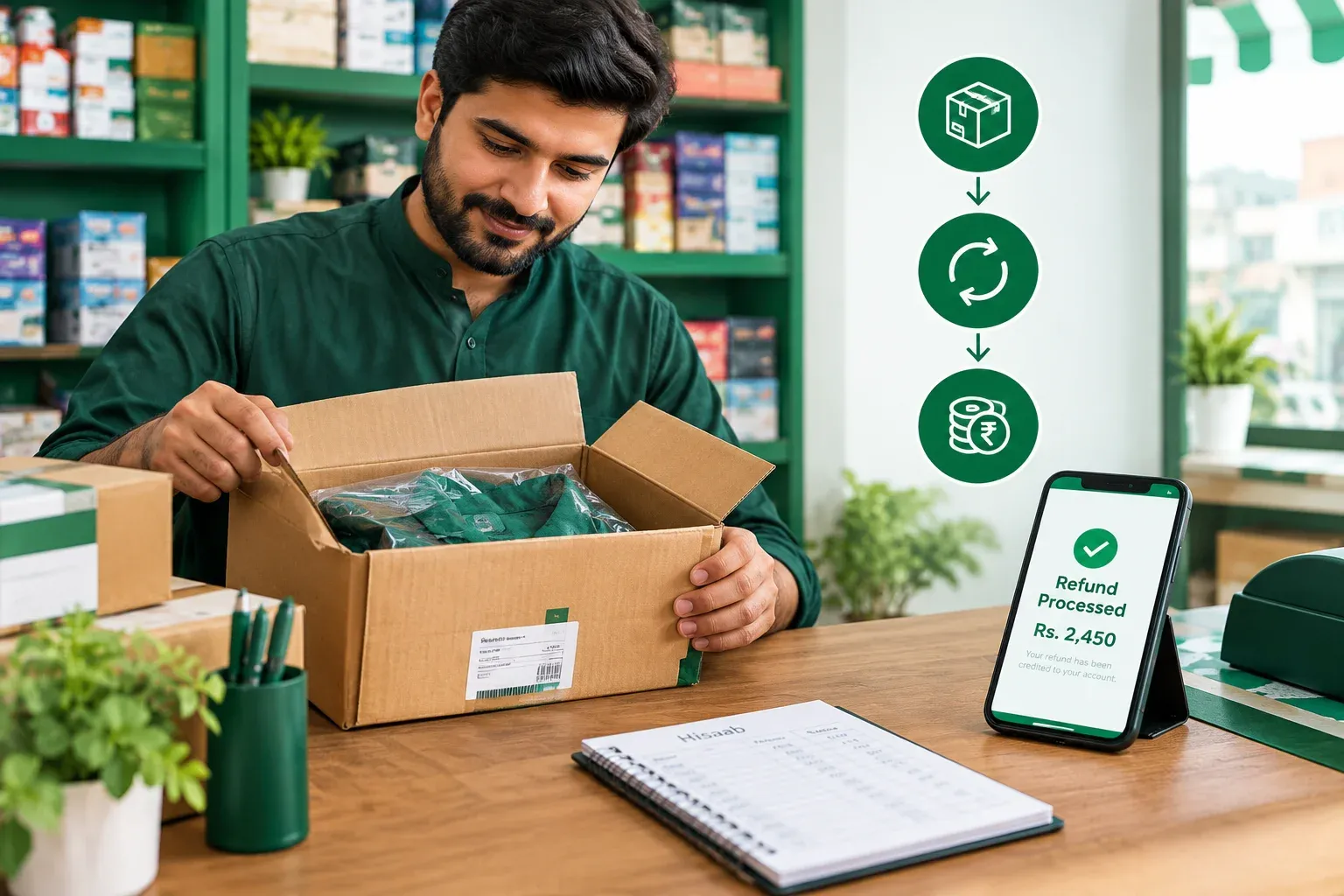
To handle returns and refunds without losing money, write a short, clear return policy before you need it, prevent avoidable returns with honest photos and order confirmation, offer exchanges or store credit before cash, inspect every returned parcel the same day, and track the reason for each return so you fix the cause instead of paying for it every month.
Why do returns and refunds cost Pakistani sellers so much?
Because in a cash on delivery market, a return costs you money twice before you have earned anything. The courier charges for the failed delivery attempt and usually again for bringing the parcel back, the stock is stuck in transit for a week or more, and if the parcel comes back damaged or opened, you may not be able to resell it at full price.
On the refund side, when a prepaid customer wants money back, you lose the sale, the courier both ways, the packaging and the time spent on messages. A Rs 2,500 kurta returned on a Rs 250 courier fee each way can wipe out the profit from the next two orders.
Returns are not a Pakistan-only problem. The National Retail Federation’s 2025 returns report estimated returns at 15.8% of US retail sales in 2025, and found that 71% of consumers are less likely to shop with a retailer again after a poor returns experience. The lesson transfers directly: handling returns badly costs you the customer as well as the parcel.
What should a return and refund policy for a small Pakistani shop say?
A good policy fits on one phone screen and answers five questions: what can be returned, within how many days, in what condition, who pays the courier, and whether the customer gets an exchange, store credit or cash. Write it before your first return, not after your first argument.
- Return window: a fixed number of days from delivery, commonly 3 to 7 for clothing and accessories. Short enough to limit abuse, long enough to be fair.
- Condition: unused, unwashed, with tags and original packaging. Say it plainly, because “like new” means different things to different people.
- What cannot be returned: custom-stitched items, innerwear, cosmetics that have been opened, sale items if you choose. Be specific.
- Who pays return courier: the customer if they changed their mind; you if the product was wrong, damaged or not as described. This single rule removes most disputes.
- What they get: exchange first, store credit second, cash refund only for your mistakes. More on why below.
- How to start a return: a WhatsApp number or a form, with photos of the item required before approval.
- How long a refund takes: once the parcel is back and checked, within a stated number of days, by the same method they paid.
Put the policy on your website, in your WhatsApp Business profile, and in your order confirmation message. A policy the customer saw before buying is one they rarely argue with.
How do you prevent returns before they happen?
Most returns are caused before the parcel ships, which means most are preventable. Shops that track reasons find the same four causes.
Photos that oversell the product
A filtered photo sells more today and returns more tomorrow. Shoot in natural light, show real colour, include a photo in hand or on a person for scale, and photograph the flaws in a sale item.
Missing size and measurement details
For clothing and shoes, list actual measurements in inches, not just S, M and L. A Lahore boutique that adds chest and length measurements to every kurta listing will see fewer size exchanges within a month.
Orders that were never confirmed
Confirm every COD order on WhatsApp or by call before dispatch: product, size, price, address, delivery time. An unconfirmed order is the most common source of parcels refused at the door. Our guide on cash on delivery in Pakistan covers this and fake orders in detail.
Unclear delivery times
Tell the customer “4 to 6 working days to Peshawar” before they order and again when you dispatch. Customers who know when to expect a parcel do not cancel it on day three.
Should you offer exchange, store credit or cash refunds?
Offer them in that order. An exchange keeps the sale and often the customer. Store credit keeps the money in your shop and brings the customer back. A cash refund loses the sale, the courier costs, and usually the customer.
For your own mistakes, a wrong item, a damaged parcel, a product that does not match the listing, refund promptly and in full, including return courier. That is the cheapest way to keep a customer who would otherwise warn ten others on Facebook.
For changes of mind, offer exchange or credit, and make the customer pay the return courier. A small restocking charge on change-of-mind returns is legal and common, but state it in the policy up front and keep it reasonable.
Refund the way the customer paid: JazzCash to JazzCash, bank to bank. For delivered COD orders that come back, refund by JazzCash, EasyPaisa or bank transfer once the parcel is checked, and keep the transaction reference.
What are your legal obligations for returns in Pakistan?
Pakistan’s provincial consumer protection laws give buyers the right to a remedy for defective goods, and they apply to online sales even though they never mention the internet. The Punjab Consumer Protection Act 2005 defines a consumer simply as someone who buys a product for a consideration, lets the Consumer Court order a seller to remove a defect, replace the product or return the price, and requires a seller to respond to a consumer’s written notice within fifteen days. Sindh, Khyber Pakhtunkhwa, Balochistan and Islamabad have their own consumer protection laws with similar remedies.
Two things matter for a small seller. First, these laws cover defective or misdescribed goods, not changes of mind; you are not legally required to accept a return because the customer no longer likes the colour, which is why your own policy should define that. Second, the Government of Pakistan’s e-Commerce Policy expects online businesses to set up a customer support system and a dispute resolution mechanism, and to acknowledge complaints with a process and timeline. A clear policy and a WhatsApp number that actually replies satisfies that expectation for most small shops.
This is general information, not legal advice. If a dispute reaches a consumer court, talk to a lawyer.
How do you process a return without losing money?
Treat each return as the same seven steps every time. Consistency is what stops money leaking.
- Ask for photos before approving. A photo of the problem resolves many requests on the spot: a replacement part, a partial credit, or spotting an item that was clearly used.
- Give the customer the return steps in one message: pack it, which courier, your address, and that the refund or exchange starts when the parcel is checked.
- Decide who books the courier. For your mistakes, book the pickup yourself so you control the cost. For change-of-mind, the customer sends it and pays.
- Inspect the parcel the same day it arrives. Check tags, wear, smell, and whether it is the item you sent. Photograph it on opening.
- Act within your stated time. Exchange ships, credit is issued, or the refund goes out with a reference number, and you message the customer to say so.
- Restock or write off. Resellable items go back to stock immediately. Damaged ones go into a clearance pile, not onto a shelf where they get forgotten.
- Log it. Order number, reason, cost to you, outcome. This log is the whole point of the next section.
When should you NOT accept a return?
Saying no is sometimes the right answer, and a clear policy lets you say it politely.
Do not accept returns of custom or made-to-measure items unless you made an error, because they cannot be resold. Do not accept items returned outside the window or without tags, unless the customer is a good repeat buyer and the goodwill is worth more than the item. Do not refund before the parcel is back and checked, however urgent the customer sounds; refund-before-return is the most common way small shops get cheated. And do not accept returns from a number that has returned three of its last four orders; ask for prepayment instead.
There is a trade-off. A strict policy protects margin but can push away honest customers, and in a market where buyers are already nervous about paying online, a reputation for difficult returns costs sales you never see. Be generous where it is your fault, firm where it is not, and say so in advance.
How do you track returns so they stop costing you?
Measure three numbers each month: return rate, cost per return, and the top three reasons. Return rate is returned orders divided by shipped orders. Cost per return is courier both ways plus any write-off, divided by the number of returns. The reasons tell you what to fix.
A Karachi mobile accessories seller who finds that half of returns say “wrong item” has a packing problem. A Faisalabad cloth seller whose returns say “colour different” has a photo problem. Neither needs a tighter policy; they need to fix the cause and watch the rate fall.
Keeping this hisaab by hand works until orders grow, which is one reason we are building Dukaandar, a Pakistan-made store platform designed around how shops here actually sell. It is still in development. For the broader picture, our guide on how to sell online in Pakistan in 2026 covers channels, couriers and costs.
Frequently Asked Questions
What is a return and refund policy?
A return and refund policy is the written rule that tells customers what they can return, within how many days, in what condition, who pays the return courier, and whether they receive an exchange, store credit or cash. For a small shop in Pakistan it should fit on one phone screen and appear on the website, the WhatsApp Business profile and the order confirmation.
How much do returns cost a seller in Pakistan?
Usually two courier charges, one for the delivery attempt and one for the return, plus packaging, the time spent on messages, and any loss if the item comes back damaged or unsellable. On low-priced items the two courier fees can exceed the profit on the sale, so one return can cancel out several successful orders.
How long should a return window be?
Between 3 and 7 days from delivery is common for clothing, accessories and small goods in Pakistan. Shorter windows reduce abuse; longer windows build trust and suit higher-priced items. Pick one number, state it clearly, and count from the delivery date so disputes about “when the week started” do not happen.
Is store credit better than a cash refund?
For the seller, yes. Store credit keeps the money in your business and brings the customer back for another order, while a cash refund loses the sale and the courier costs. Offer exchange first, store credit second, and reserve cash refunds for your own mistakes such as wrong, damaged or misdescribed items, where a quick full refund protects your reputation.
Are sellers in Pakistan legally required to accept returns?
For defective or misdescribed goods, provincial consumer protection laws such as the Punjab Consumer Protection Act 2005 allow a consumer court to order repair, replacement or a refund, and require sellers to respond to a written complaint within fifteen days. For change-of-mind returns there is no general legal requirement, so your own policy decides. This is general information, not legal advice.
Should I refund before the returned parcel arrives?
No. Refund only after the parcel is back and checked, and say so in your policy. Refunding first is the most common way small sellers lose money to returned parcels that never arrive or arrive used. For your own clear mistakes with a trusted repeat customer you can make an exception, but keep it an exception.
How do I handle a customer who returns too often?
Keep a log by phone number. When a customer has returned most of their recent orders, politely require prepayment for the next order or decline change-of-mind returns for them. Most serial returners stop ordering once prepayment is required, which is the outcome you want.
Conclusion
Returns and refunds stop losing you money when they stop being surprises. Write the policy, prevent the avoidable returns with honest photos and confirmed orders, offer exchanges before cash, check every parcel before you pay out, and log the reasons so each month has fewer returns than the last. If you want a store built for how Pakistani shops sell, COD and returns included, join the Dukaandar waitlist and we will tell you first when it is ready.