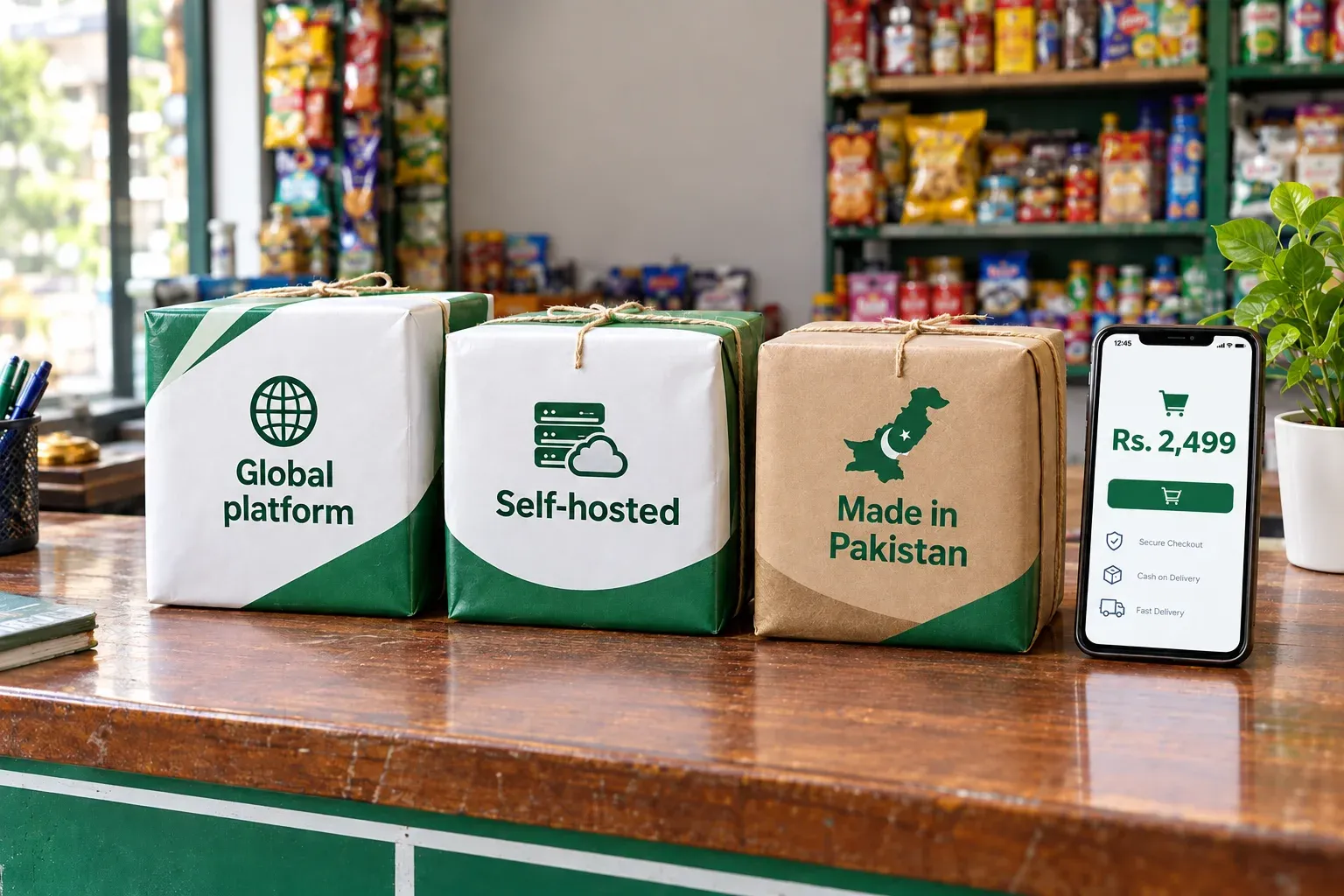
Shopify vs WooCommerce vs local platforms comes down to three trade-offs for a Pakistani shop. Shopify is the easiest but bills in US dollars and does not offer Shopify Payments here. WooCommerce is free software but needs hosting and a developer. A local platform built in Pakistan, such as Dukaandar, is designed around rupees, cash on delivery and local couriers from the start.
Shopify vs WooCommerce vs local platforms: what are the real options?
There are three types of platform a Pakistani business can build a store on: a global hosted platform like Shopify or Wix, open-source software like WooCommerce that you host yourself, or a platform built in Pakistan for Pakistani selling, such as Dukaandar. Each type answers the same five questions differently: what it costs in rupees, how you get paid, who does the technical work, whether it understands COD and local couriers, and who you call when something breaks at 10 pm. Prices below were checked on 15 September 2026 and converted at the interbank rate of Rs 277.70 per US dollar.
Is Shopify a good choice for a Pakistani business?
Shopify is the easiest platform to set up and the most polished, and that ease comes with two Pakistan-specific catches: dollar billing and no Shopify Payments.
What Shopify costs in Pakistan
Shopify’s own Pakistan pricing page lists the Basic plan at US$25 a month on monthly billing or US$19 a month billed yearly, Grow at US$65 or US$49, and Advanced at US$399 or US$299, with a three-day trial and then US$1 a month for three months, per Shopify’s Pakistan pricing page. At Rs 277.70 to the dollar, Basic on monthly billing is roughly Rs 6,950 a month, and that figure rises every time the rupee weakens. You also need an international card to pay, which many shop owners do not have.
How you get paid on Shopify in Pakistan
This is the part most guides skip. Pakistan is not on the Shopify Payments supported countries list, which names 40 countries and none in South Asia. Shopify’s help centre says that if your country is not listed, “you need to use a third-party payment provider.” That means arranging your own gateway for cards, JazzCash and EasyPaisa, and paying Shopify’s third-party fee on top of the gateway’s charges: 2% on Basic, 1% on Grow, 0.6% on Advanced. COD works through manual payment settings, but courier booking and COD reconciliation need apps or manual work.
Who Shopify suits
English-comfortable D2C brands in Karachi, Lahore or Islamabad with a card for USD billing, an agency on call for apps, and enough volume that Rs 7,000 to 18,000 a month plus fees is a small line item. For a Faisalabad cloth seller doing thirty COD orders a week, the dollar bill and the payments workaround are hard to justify.
Is WooCommerce a good choice for a Pakistani business?
WooCommerce is the cheapest platform on paper and the most expensive in time. It is a free plugin for WordPress, and everything around it is your responsibility.
What WooCommerce costs in Pakistan
The software is free. WooCommerce’s own pricing page says it is “free to download and use” with “no platform fees, no revenue share,” and then lists what you pay for: hosting at “$25 to $350 per month for most stores” and extensions at “$29 to $299 per year per extension.” Add a domain, a theme, and, for most shop owners, a developer to set it up and keep it running. Pakistani hosts offer cheaper rupee-priced hosting, but cheap hosting is often slow hosting, and a slow store on a 3G connection in Multan loses sales.
How you get paid on WooCommerce
You choose your own gateway, and WooCommerce charges nothing extra for it. COD is built in as a payment method. Local gateways and courier plugins exist for Pakistan, but quality varies, updates break things, and you or your developer will be the one fixing it.
Who WooCommerce suits
Businesses that already have a trusted developer, want full control over every page, or have unusual requirements. If you have someone who enjoys WordPress, WooCommerce can be the cheapest long-term option. If the phrase “update the plugin” makes you nervous, it will cost you more than Shopify in stress.
What about Wix and other global builders?
Wix sits between the two: hosted and easy like Shopify, with weaker e-commerce depth. Wix’s plans page shows US dollar prices billed yearly, from US$17 a month for Light to US$159 for Business Elite; the cheapest plan that accepts payments is Core at about US$29, roughly Rs 8,050. Payments for Pakistan are limited in the same way as Shopify, and COD and local couriers are not a focus. Wix suits a service business with a few products, not a shop shipping fifty parcels a week.
Is a local platform like Dukaandar a good choice for a Pakistani business?
A local platform is built around how selling works in Pakistan rather than adapted to it afterwards. Global platforms assume customers pay by card before the parcel ships. Pakistan is a COD market with JazzCash and EasyPaisa, TCS and Leopards, Urdu-speaking customers, and shop owners who run the business from a phone. Dukaandar is being built in Pakistan for exactly that market, positioned as simpler than Shopify, and here is how it compares on the same five points.
What a local platform costs
The point of a Pakistan-built platform is a price you can pay locally: in rupees, without an international card, and without the bill rising every time the dollar does. Dukaandar is designed around that principle. It is still in development, so plans are not published yet; when it launches, compare its rupee price directly against Shopify’s Rs 6,950 a month and WooCommerce’s hosting-plus-developer total.
How you get paid on a local platform
Cash on delivery is treated as the normal way to sell, not a workaround, with JazzCash, EasyPaisa and bank transfer alongside it. Dukaandar is being built so that a COD-heavy shop does not need a third-party app or a developer to take orders and get paid the way Pakistani customers actually pay.
Who does the technical work
You do, and that is the design goal: a shop owner should be able to set up and run the store from a phone without hiring anyone. Dukaandar’s whole reason to exist is to be easier than Shopify for someone who has never built a website.
COD, couriers and support
Local couriers such as TCS, Leopards and Trax, and support in Urdu on Pakistani hours, are what a global platform cannot offer and a Pakistani team can. When something breaks at 10 pm on a Blessed Friday weekend, a Karachi support team versus a ticket answered next morning in another time zone is a night of lost sales.
Who a local platform suits
Small shops, boutiques and traders in cities like Faisalabad, Sialkot, Gujranwala and Multan who sell mostly COD, want their own store rather than a Daraz listing, and do not have a developer or a dollar card. If that is you, a platform like Dukaandar is built for your situation in a way Shopify and WooCommerce are not.
The honest limitation is maturity. Shopify and WooCommerce have years of themes, apps, tutorials and freelancers behind them. Dukaandar is new and still in development, and you should ask hard questions about reliability, uptime and data export before committing to any platform, ours included. We would rather you compare Dukaandar on those questions when it launches than take our word for it now.
When should you NOT switch platforms?
Switching costs time, and sometimes the right answer is to stay put. If you are already on Shopify or WooCommerce and it works, the dollar bill is affordable and your developer is reliable, do not migrate just because a local option exists. Moving products, customers, order history and a domain is a project, and doing it before Blessed Friday or during shaadi season is how shops lose their busiest month.
If you are doing under twenty orders a week on WhatsApp, you may not need any of these platforms yet. Prove the product first; our guide on how to sell online in Pakistan in 2026 covers when a store makes sense at all. And be wary of any platform, local or global, that cannot show you how to export your data.
Shopify vs WooCommerce vs local platforms: how do you choose?
Ask five questions and the answer usually falls out.
- Can I pay in US dollars every month without it hurting? If no, Shopify and Wix are hard to sustain.
- Do I have a developer I trust and can afford? If no, WooCommerce will cost more than it looks.
- Is most of my business COD with local couriers? If yes, a platform that treats COD as normal will save you hours every week.
- Do I need advanced features today, such as multi-currency selling abroad? If yes, Shopify’s app ecosystem is hard to beat.
- Who will answer when something breaks, and in what language? If you want Urdu support on Pakistani hours, that narrows the list quickly.
A Sialkot exporter selling gloves to Europe by card should probably be on Shopify. A Lahore boutique doing COD across Punjab should look hard at a Pakistan-built platform like Dukaandar. A business with an in-house WordPress developer can make WooCommerce work well. None of these is wrong; they answer different questions.
Frequently Asked Questions
Which is better in Pakistan, Shopify or WooCommerce?
Shopify is easier to set up and run but bills in US dollars and requires a third-party payment gateway in Pakistan with a 2% fee on the Basic plan. WooCommerce is free software but needs hosting, a domain and usually a developer. For a shop without technical help and a card for dollar billing, neither fits perfectly, which is why local platforms exist.
How much does Shopify cost in Pakistan?
Shopify’s Pakistan pricing page lists Basic at US$25 a month on monthly billing or US$19 billed yearly, about Rs 6,950 or Rs 5,280 at the 15 September 2026 interbank rate. Grow is US$65 or US$49, Advanced US$399 or US$299. Add a 2% third-party payment fee on Basic because Shopify Payments is not available in Pakistan, plus your gateway’s own charges.
Is Shopify Payments available in Pakistan?
No. Shopify’s help centre lists 40 supported countries for Shopify Payments and Pakistan is not among them. Pakistani merchants must use a third-party payment provider and pay Shopify’s third-party transaction fee, which is 2% on Basic, 1% on Grow and 0.6% on Advanced, on top of the provider’s own fees.
Is WooCommerce really free?
The plugin is free with no platform fees or revenue share, according to WooCommerce’s pricing page. You pay for hosting, which WooCommerce estimates at US$25 to US$350 a month for most stores, extensions at US$29 to US$299 a year each, a domain, and usually a developer. The total is often lower than Shopify over time, but only if you have someone to maintain it.
Can I accept cash on delivery on Shopify or WooCommerce?
Yes on both. Shopify supports COD through manual payment methods, and WooCommerce includes COD as a built-in option. The difference is what happens after the order: confirming it, booking the courier, tracking the return and reconciling the cash. On global platforms that usually needs apps, plugins or manual work; on a platform built for Pakistan it should be part of the normal flow.
What is the best e-commerce platform in Pakistan for a small shop?
It depends on three things: whether you can pay in dollars, whether you have a developer, and how much of your business is COD. Shopify suits card-paying brands with technical help. WooCommerce suits businesses with a trusted developer. A Pakistan-built platform like Dukaandar suits shops that want rupee pricing, COD, local couriers and Urdu support without hiring anyone.
Dukaandar vs Shopify: what is the difference?
Shopify is a mature global platform billed in US dollars, with no Shopify Payments in Pakistan and a third-party payment fee on every sale. Dukaandar is a newer platform built in Pakistan, currently in development, designed to be simpler than Shopify and built around cash on delivery, JazzCash, EasyPaisa, local couriers and Urdu support. Shopify wins on app ecosystem and track record; Dukaandar is built for how Pakistani shops actually sell.
Conclusion
Shopify, WooCommerce and local platforms each solve a different problem. Shopify buys ease at a dollar price with a payments workaround. WooCommerce buys control at the price of a developer. A Pakistan-built platform like Dukaandar aims to make COD, local payments and couriers normal instead of an afterthought. Pick the one that matches how you actually sell, not the one with the biggest name. If you want a store made for Pakistani shops that is easier than Shopify, join the Dukaandar waitlist and we will tell you first when it is ready.