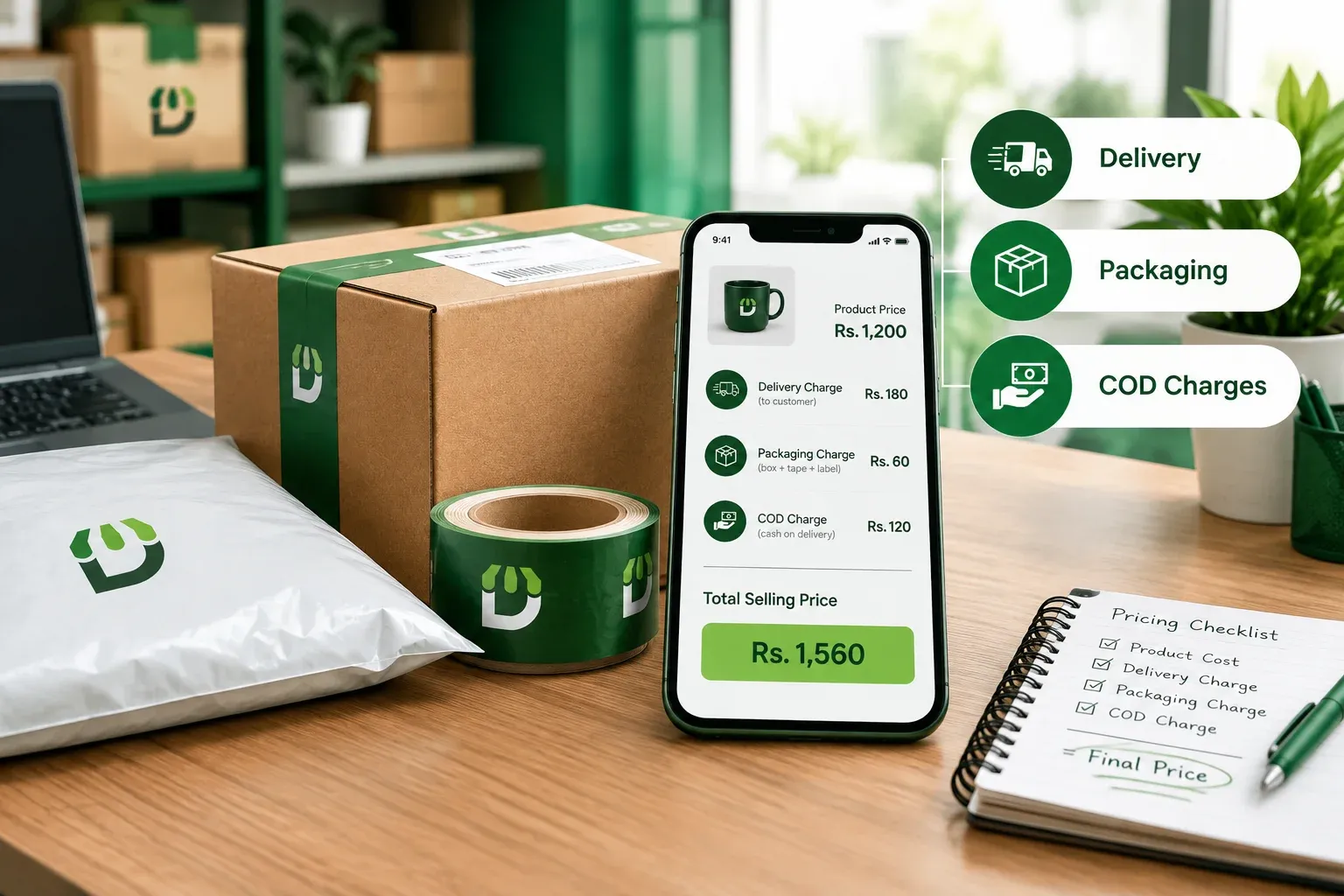
To price products for online selling in Pakistan, start with your cost price, add every per-order cost you actually pay (courier, COD fee, packaging, payment charges, a share of returns), decide who pays delivery, then add the profit you need and check the result against what customers will pay. Most shops that lose money online priced the product and forgot the parcel.
Why does online pricing go wrong for Pakistani sellers?
Because the shop price and the online price are not the same price, and most sellers copy the first one. In the shop, a customer pays and leaves. Online, every order carries a courier charge, a COD collection fee, a flyer bag, a payment charge if they prepaid, and a real chance the parcel comes back. Price the product alone and those costs come out of your profit, one order at a time, until the hisaab shows a loss on a business that felt busy.
DHL’s guidance for Pakistani e-commerce sellers puts the national COD return-to-origin rate at roughly 18 to 20%, and each return usually costs courier charges both ways. A price that ignores that is a price that works four orders out of five and loses on the fifth.
What costs should an online price include?
Seven, and you should know each as a rupee figure per order before you set a price.
- Cost price: what you paid for the item, or materials plus your time if you make it.
- Courier charge: the delivery fee for the parcel’s weight and destination zone. Ask your courier for the rate card; it changes with weight, city and fuel prices.
- COD handling fee: what the courier charges to collect cash at the door, usually a small percentage of the collected amount or a flat fee per parcel. It is separate from delivery.
- Packaging: the flyer bag, box, tape, bubble wrap and any branded insert. Buy in bulk and divide by quantity to get a per-order cost.
- Payment charges: for prepaid orders, the fee your JazzCash, EasyPaisa or bank merchant account charges. For COD, zero here but see item 3.
- Returns allowance: your return rate multiplied by what a return costs you, spread across all orders. If one in five parcels comes back and each return costs Rs 400 in courier both ways, that is Rs 80 added to every order.
- Platform and marketing costs: your store subscription, marketplace commission if you sell on Daraz, and ad spend, divided by your monthly order count.
Add these and you have your true landed cost per order. Price from that number, not from the cost price.
How do you calculate an online selling price step by step?
Here is the method with a worked example. The figures are illustrative; swap in your own courier rate card and real numbers.
A Faisalabad seller sells a lawn kurta that costs Rs 1,200 to stock. Their courier charges Rs 180 for a 500 g parcel within Punjab and a COD fee of Rs 40 per parcel. Packaging is Rs 30. Their return rate last month was 15%, and a return costs them Rs 360 in courier both ways. They do 100 orders a month on a Rs 2,500 store subscription.
- Cost price: Rs 1,200.
- Courier: Rs 180.
- COD fee: Rs 40.
- Packaging: Rs 30.
- Returns allowance: 15% of Rs 360 is Rs 54.
- Platform cost per order: Rs 2,500 divided by 100 orders is Rs 25.
- True cost per delivered order: Rs 1,200 plus 180 plus 40 plus 30 plus 54 plus 25 equals Rs 1,529.
Now decide the profit. If the seller wants Rs 500 profit per order, the customer must pay Rs 2,029 in total. How that is presented is the next decision.
If delivery is charged separately at Rs 200, the product price is Rs 1,829 and the checkout shows Rs 1,829 plus Rs 200 delivery. If delivery is “free”, the product price is Rs 2,029. Same money, different psychology.
One check before publishing: does Rs 2,029 make sense against what the customer sees elsewhere? If competitors sell a similar piece for Rs 1,800 delivered, you have a margin problem, not a pricing problem, and the fix is a cheaper source, a better product or a bundle, not a thinner price.
Should delivery be free, charged, or included in the price?
Charge delivery separately for low-priced items, offer free delivery above a threshold, and show the total before checkout either way. Pakistani buyers compare total price including delivery, and the ones who refuse parcels at the door are often the ones surprised by the courier charge.
Free delivery built into the price
Works for products above roughly Rs 2,000 where a Rs 200 courier charge disappears inside the price. It raises conversion and reduces cancellations. The risk is that a customer in Karachi and one in Gilgit cost you different amounts, and you absorb the difference.
Delivery charged separately
Works for low-priced items where adding Rs 200 to a Rs 600 product would make it look expensive. State it in the listing, the catalogue and the confirmation. A charge the customer saw before ordering is rarely refused.
Free delivery above a threshold
The best of both for most shops. “Free delivery on orders over Rs 3,000” raises the average order, because customers add a second item to cross the line. Set the threshold at about 1.5 times your current average order value, and state it everywhere the customer sees a price.
How do COD charges change your pricing?
COD adds two costs that prepaid orders do not have: the courier’s collection fee and a much higher return risk. Price for COD as the default, because most of your orders will be COD, and then make prepaid slightly cheaper rather than making COD visibly more expensive.
Build the COD fee and the returns allowance into your base price, then offer a small discount or free delivery for JazzCash, EasyPaisa or bank transfer. The prepaid customer sees a reward; the COD customer sees a normal price. Over time the prepaid share grows and your average cost per order falls. Our guide to cash on delivery in Pakistan covers the return side of this in detail.
Do not add a visible “COD charge” at checkout. Customers in Pakistan read it as a penalty and leave.
How should you price on Daraz versus your own store?
Price higher on Daraz, or at least never lower, because Daraz takes a commission and fees out of every sale that your own store does not. Daraz states that it charges no listing fee and deducts a commission that depends on the product category, per the Daraz sell-on-Daraz page, plus shipping and voucher contributions that vary by programme.
Work out your Daraz cost per order the same way, adding commission and fees as a percentage of the selling price, then set the Daraz price so profit per order matches your own store. Many sellers keep Daraz 5 to 15% higher and give repeat customers a reason to order direct: a small discount, a gift, or faster delivery. The customer list from your own store is worth more than the extra Daraz volume.
What pricing mistakes lose money online?
The same ones, in every category and every city.
Copying the shop price. The shop price has no courier in it.
Ignoring returns. A 20% return rate on a product with Rs 150 profit per order is a loss-making product, however good the sales look.
Forgetting packaging. Rs 30 a parcel is Rs 3,000 a month at 100 orders. It is a cost, not a rounding error.
Pricing by competitor only. If a competitor’s price does not cover your costs, they are sourcing cheaper or losing money. Matching them without checking your numbers is how you join the second group.
Discounting without a floor. A Blessed Friday discount that drops the price below true landed cost sells a lot of parcels at a loss. Know your floor price, the number below which you lose money on every order, before any sale.
Never revising. Courier rates, fuel, packaging and the rupee all move. Re-run the numbers every quarter.
When should you NOT follow this method?
Very low-priced items, under about Rs 500, cannot carry a courier charge and a returns allowance individually. Sell them in bundles or sets so one parcel carries enough margin, or make them add-ons to larger orders rather than standalone listings.
Loss leaders are fine on purpose. Selling one popular item near cost to bring customers in works if the rest of the basket makes money, and stops working when the loss leader is the only thing people buy.
Custom and made-to-order products need a deposit and a quote, not a fixed list price, because the cost is not known until the order is specified.
If you are new and do not know your return rate yet, assume 20% and use the courier’s rate card, then replace both with real numbers after your first fifty orders. A rough price with a margin beats a precise price with none.
How do you keep prices right as costs change?
Keep a pricing sheet with one row per product: cost, courier, COD fee, packaging, returns allowance, platform cost, target profit, selling price, floor price. Update courier and packaging when a rate changes, and the return rate monthly from your hisaab. When a selling price drops below its floor, you know before the loss arrives.
This per-order maths gets tedious by hand at a hundred orders a month, which is part of why we are building Dukaandar, a Pakistan-made store platform designed around how shops here sell, COD and couriers included. It is still in development. For the broader picture of running a store, see our guide on how to sell online in Pakistan in 2026.
Frequently Asked Questions
How do I price a product for online selling?
Add up your true cost per delivered order: cost price, courier charge, COD fee, packaging, payment charges, a returns allowance and your platform or marketing cost per order. Then add the profit you need and check the total against what customers will pay. Decide separately whether delivery is shown as free, charged, or free above a threshold.
How much does it cost to deliver a parcel in Pakistan?
It depends on the courier, the parcel weight and the destination zone, and rates change with fuel prices, so ask your courier for a current rate card rather than relying on a figure from a blog. Add the courier’s COD collection fee, which is charged separately from delivery, and remember that a returned parcel is usually charged both ways.
Should I offer free delivery in Pakistan?
For products above roughly Rs 2,000, yes, build the courier charge into the price and call it free delivery; it raises conversion and cuts refusals. For cheaper items, charge delivery separately and say so clearly. For most shops the best option is free delivery above a threshold set at about 1.5 times your average order value.
Is it better to price higher on Daraz or on my own website?
Price higher on Daraz, or at least not lower, because Daraz deducts a category-based commission and fees from every sale that your own store does not. Set the Daraz price so your profit per order matches your own store, and give repeat customers a reason to order direct, where you keep the full margin and the customer’s details.
How do I include returns in my product price?
Multiply your return rate by what a return costs you, and add that to every order. If 15% of parcels come back and each return costs Rs 360 in courier both ways, add Rs 54 to each order’s cost. Track your real return rate monthly; the Pakistan average for COD e-commerce is around 18 to 20% according to DHL’s guidance for Pakistani sellers.
What is a floor price?
The lowest price at which an order still covers all its costs: product, courier, COD fee, packaging, returns allowance and platform share. Below it, every sale loses money. Know the floor for each product before running any discount, especially for Blessed Friday and shaadi season sales, when it is easy to sell a lot of parcels at a loss.
Conclusion
Online pricing is shop pricing plus the parcel: courier, COD fee, packaging, payment charges, a share of returns and a share of your platform costs, then profit, then a sanity check against the market. Know each of those as a rupee figure, keep a pricing sheet with a floor price per product, and revise it when the courier or the rupee moves. If you want a store built for how Pakistani shops sell, join the Dukaandar waitlist and we will tell you first when it is ready.