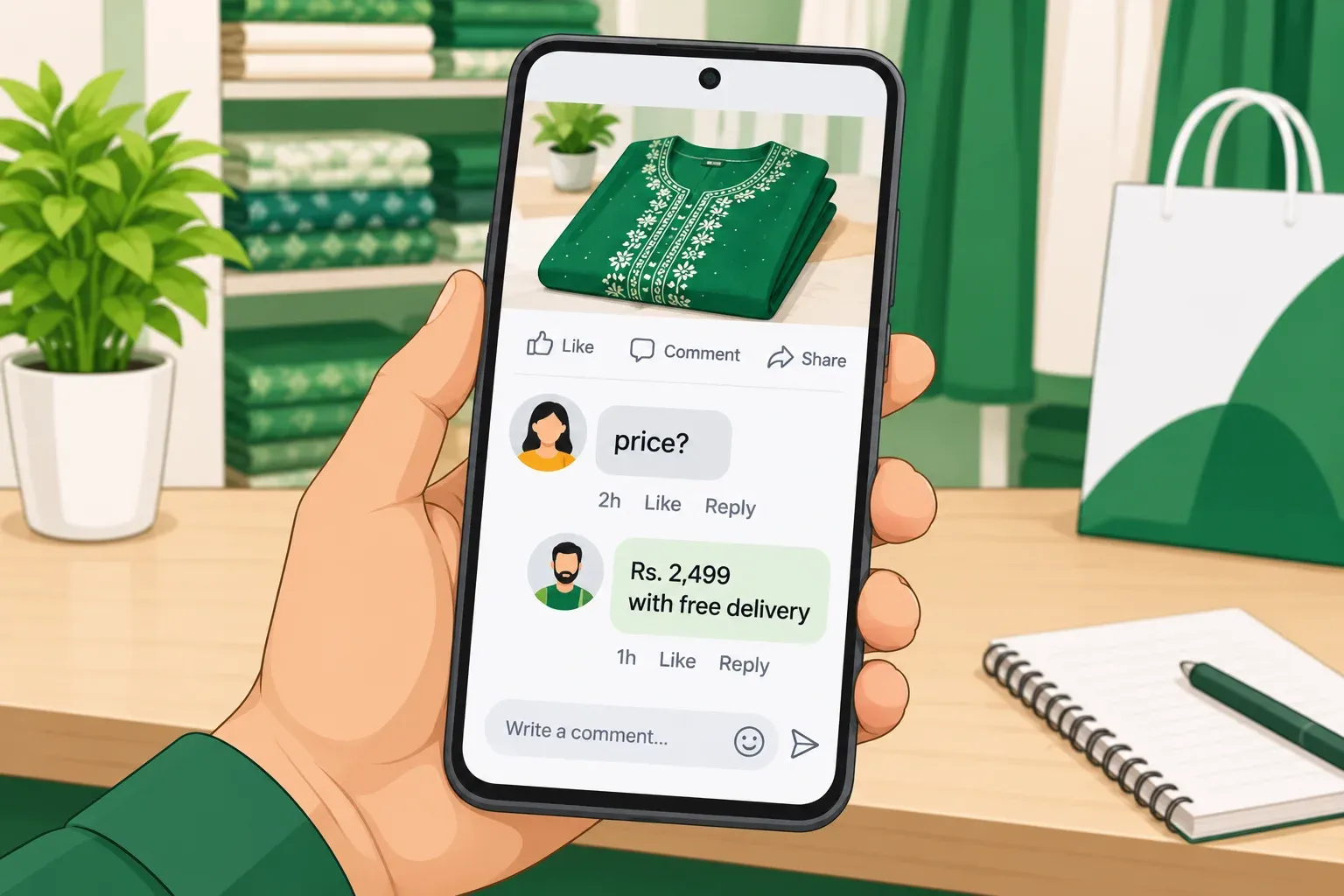
To reply to “price?” comments without losing the sale, answer with the price in the comment itself, add the delivery charge and one line on how to order, and move the conversation to WhatsApp or your product link in the same message. Never reply “inbox” or “DM for price”. The customer who asked publicly will buy publicly if you let them, and so will the ten people reading the thread.
Why does “price?” get asked so often in Pakistan?
Because sellers trained customers to ask. Years of “DM for price” posts taught Pakistani buyers that the price is hidden, negotiable, or depends on who is asking, so even when the price is in the caption, people ask anyway. On Facebook in particular, where the Digital 2026: Pakistan report from DataReportal puts ad reach at 52.9 million people, commenting is how buyers in smaller cities interact with a page; a comment is a knock on the shop door.
That is the part sellers get wrong. “Price?” is not a nuisance. It is a buying signal from someone who stopped scrolling, looked at your product, and raised their hand in public. What happens in the next reply decides whether that hand becomes an order, and whether the next twenty people who read the thread see a shop that answers or a shop that hides.
Why does “inbox” or “DM for price” lose the sale?
Because it adds a step, and every added step loses buyers. The customer has to open a chat, you have to notice it among forty others, you reply when you can, and by then they have scrolled on or bought from the page that answered in the comment. The people reading the thread, who were half-interested, learn nothing and leave.
It also reads badly. A hidden price signals that it is high, that it changes by customer, or that the seller is not confident. Buyers in Pakistan are already cautious about paying a stranger online; secrecy about the price adds to the caution rather than building the trust that makes a stranger order.
The honest reason sellers hide prices is fear: of competitors copying, of customers comparing, of haggling in public. Competitors already know your prices. Customers compare anyway. And a stated price with a clear policy ends haggling better than a DM negotiation ever does. Our guide on product descriptions in Urdu and English that sell covers putting the price in the caption in the first place, which prevents most of the comments.
What should a good “price?” reply contain?
Four things, in one short message: the price, the delivery charge or free-delivery rule, how to order, and a light push toward the next step. Fifteen to thirty words is enough. Anything longer gets skimmed.
- The price, as a number, with Rs. Not “check caption”, not “inbox”.
- Delivery, stated or included. “Delivery Rs 200” or “free delivery nationwide”. The surprise courier charge is the biggest cause of refused COD parcels, so kill it here.
- How to order. A WhatsApp number, or a product link if you have a store. One, not both; too many options stall people.
- A nudge. “Order kar lein, 3 din mein pohanch jayega” or “only 4 left in medium”. Specific and true, never fake scarcity.
Add the customer’s name if it is visible. “Ayesha, Rs 2,450 + delivery Rs 200” reads like a shopkeeper talking, not a bot.
Price reply templates in Urdu and English
Copy, adjust the numbers, and save them as quick replies in WhatsApp Business and in your phone’s keyboard shortcuts. The mix of Roman Urdu and English is deliberate; it is how your customers write to you.
When the price is simple
Template: “Rs 2,450, delivery Rs 200. Order karne ke liye WhatsApp karein 03XX-XXXXXXX. 3 se 5 din mein deliver ho jata hai.”
English-leaning version for Instagram: “Rs 2,450 plus Rs 200 delivery. Tap the link in bio to order, delivered in 3 to 5 days.”
When delivery is free above a threshold
Template: “Rs 1,850. Rs 3,000 se upar free delivery, warna Rs 200. Order link bio mein hai ya WhatsApp 03XX-XXXXXXX.”
When there are sizes or variants
Template: “Rs 2,450, sab sizes (S, M, L, XL) same price. Delivery Rs 200. Size aur address WhatsApp pe bhej dein 03XX-XXXXXXX.”
When the product is sold out in one option
Template: “Rs 2,450. Medium khatam ho gaya, Small aur Large available hain. Delivery Rs 200. WhatsApp 03XX-XXXXXXX.”
When the customer asks for a discount in the comment
Template: “Price fixed hai, Rs 2,450, lekin prepaid pe delivery free. JazzCash ya Easypaisa se pay karein aur Rs 200 bachayein.”
This turns a haggle into a prepaid order, which is the best outcome you can get from a discount request. Our guide on which payment methods to offer and why covers the prepaid reward in detail.
When ten people have asked the same thing
Pin one reply or edit the caption: “Price: Rs 2,450. Delivery Rs 200. Order: WhatsApp 03XX-XXXXXXX.” Then reply to each new comment with “Ji, Rs 2,450, details pinned comment mein hain.” You still answer every person, but in six words.
When the question is really “is this available?”
Template: “Ji available hai, Rs 2,450, delivery Rs 200. Aaj order karein to kal dispatch. WhatsApp 03XX-XXXXXXX.”
When you cannot answer in public (custom or quoted work)
Template: “Custom order hai to price measurements pe depend karti hai, starting Rs 4,500. Details ke liye WhatsApp karein 03XX-XXXXXXX.” Even here, give a starting number. “DM for price” with no anchor loses the people who assume it is out of their range.
How fast should you reply, and how?
Within the hour during the day, and within fifteen minutes in the first hour after posting, which is when most comments arrive and when the thread is being read by the most people. A reply the next morning answers a customer who has already bought elsewhere.
Turn on comment notifications for the page, keep the templates in quick replies so each answer takes five seconds, and assign one person to comments on posting days. If you post at 9 pm, which is peak time for Pakistani social media, someone should be on the page until 10:30.
Reply in public first, then, if the customer wants to order, move to WhatsApp. Do not move to DM to give the price; move to DM to take the address.
What should you never do in a “price?” reply?
Six habits that cost sales every day on Pakistani pages.
Replying “inbox” or “DM”. Covered above; it is the single most expensive word on your page.
Replying “check caption”. If they are asking, they did not see it, and the reply reads as irritated. Just give the number.
Giving a different price in comments than in DMs. Screenshots travel. One price, everywhere.
Deleting the comment. The customer notices, and so does everyone who saw it.
Arguing about the price in public. “Market mein sasta hai” gets “ji wahan se le lein, shukriya” and nothing more.
Replying to some and ignoring others. Every unanswered “price?” is a visible lost sale to everyone reading.
When does answering in the comments NOT work?
There are a few cases where the public reply has limits, and knowing them stops you forcing it.
If your price genuinely varies by customer, such as wholesale versus retail, state the retail price publicly and say wholesale is quoted on WhatsApp. Hiding both loses the retail buyer.
If you sell on a marketplace as well, keep that platform’s rules; on Daraz, the price is on the listing and conversations stay in Daraz’s own channels.
If comments are being flooded by competitors or spam, pin the price reply and answer new comments with a short pointer to it rather than giving up on comments altogether.
And if “price?” comments are overwhelming you at hundreds a day, the fix is not a faster thumb; it is putting the price, delivery and order link in every caption and on a product page so the question stops being necessary. Our guide on whether you need a website if you already sell on WhatsApp and Instagram covers that point.
How do you stop getting “price?” comments in the first place?
Put the price in the first line of every caption, the delivery rule in the second, and the order link or number in the third. Put the price on the image itself for Facebook, where captions get cut off. Repost the product to Stories with a price sticker. Keep a pinned post with your delivery and payment policy.
You will still get the comments, because the habit is old, but you will get fewer, and each reply becomes a six-word confirmation rather than a negotiation. On a proper store, the product page answers the question before it is asked, which is one of the reasons we are building Dukaandar, a Pakistan-made store platform designed around how shops here sell. It is still in development.
Frequently Asked Questions
Should I put the price in the comments or ask customers to DM?
Put it in the comments. A public price answers the person who asked and everyone reading the thread, builds trust, and removes a step between interest and order. “DM for price” loses the customers who will not message and costs you a conversation for each one who does. Use DMs to take the address, not to reveal the price.
What is the best reply to a “price?” comment?
Price, delivery charge, how to order, and a short nudge, in one message under thirty words. For example: “Rs 2,450, delivery Rs 200. Order karne ke liye WhatsApp karein 03XX-XXXXXXX, 3 se 5 din mein deliver.” Save it as a quick reply so answering takes seconds.
How quickly should I reply to comments on my shop’s posts?
Within fifteen minutes during the first hour after posting, when most comments arrive and the most people are reading, and within an hour during the day otherwise. Have someone on the page for ninety minutes after any evening post. Next-morning replies answer customers who have already bought elsewhere.
How do I handle discount requests in public comments?
State that the price is fixed and offer a prepaid reward instead: free delivery or a small discount for JazzCash, Easypaisa or bank transfer. This turns a haggle into a prepaid order, which cannot be refused at the door, and it sets the same rule for everyone reading.
Why do customers keep asking the price when it is in the caption?
Habit, and caption truncation. Years of “DM for price” posts taught Pakistani buyers to ask, and Facebook cuts long captions so the price is often below the fold. Put the price in the first line, put it on the image, and reply with the number anyway rather than “check caption”.
Should I reply to “price?” comments in Urdu or English?
In the mix your customers use. Roman Urdu with English numbers and nouns works for most Facebook audiences; a more English-leaning reply suits Instagram buyers in big cities. Match the language of the comment itself: if they wrote “price?” in English, a reply that starts “Rs 2,450” works for everyone.
Can I reply to price comments on Daraz the same way?
On Daraz the price is already on the listing and all buyer communication must stay inside Daraz’s own channels, so there is no comment reply to write and you should not direct buyers to WhatsApp from there. The templates in this article are for your own Facebook, Instagram and WhatsApp, where the customer relationship is yours.
Conclusion
A “price?” comment is a customer at the counter. Answer with the number, the delivery charge, how to order and a nudge, in one short message, within minutes, in the language they used, and never with “inbox”. Save the templates, put the price in every caption, and watch the comments turn from questions into orders. If you want a store where the product page answers the question before it is asked, join the Dukaandar waitlist and we will tell you first when it is ready.