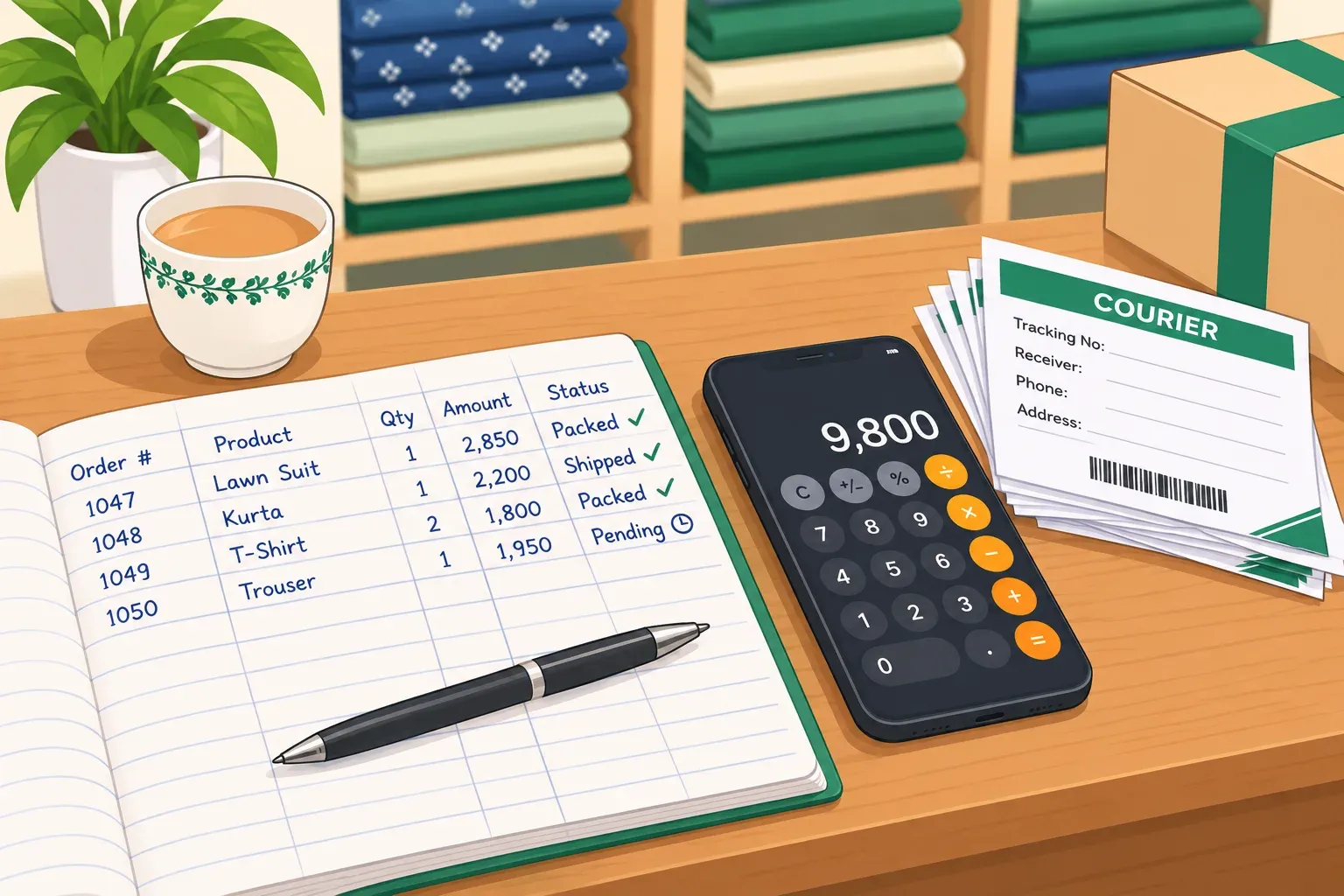
To keep hisaab for an online shop, record every order on one line (date, order number, channel, items, cost price, selling price, courier, COD fee, packaging, payment method, delivered or returned), add a second short list for monthly costs like subscriptions and ads, and at month end subtract everything from what customers actually paid. Fifteen minutes a day gives you a true profit figure that most sellers never see.
Why do online sellers not know their real profit?
Because online selling scatters the numbers across five places and none of them talks to the others. Sales sit in WhatsApp chats and a website dashboard. Courier charges sit in a courier portal and get deducted before remittance. COD cash arrives weeks later as a lump sum. Returns come back as parcels, not as entries. Packaging was bought in bulk two months ago. Ad spend is on a card statement.
So the seller looks at “5 lakh ki sale” and feels good, then wonders at month end why the bank balance has not moved. The sale was real. So were the courier fees on every parcel, the two-way charges on the roughly one in five COD parcels that came back, the packaging, the wallet fees, the subscription and the ads. DHL’s guidance for Pakistani e-commerce sellers puts the national COD return rate at 18 to 20%, and a seller who is not writing returns down is not counting one of their biggest costs.
The fix is not accounting software. It is one sheet, filled in daily, read once a month.
What should an online shop’s hisaab sheet contain?
Two tabs, or two pages in a notebook: an order log with one line per order, and a monthly costs list. That is the whole system.
The order log, one line per order
- Date
- Order number
- Channel: website, WhatsApp, Instagram, Facebook, Daraz
- Items and quantity
- Cost price of the items (what you paid for them)
- Selling price the customer agreed
- Delivery charged to the customer (zero if free)
- Courier charge you paid
- COD fee, if the order was COD
- Packaging cost (your per-parcel figure)
- Payment method: COD, JazzCash, Easypaisa, bank
- Status: delivered, returned, cancelled
- Return cost, if it came back (the second courier leg)
- Marketplace commission, if sold on Daraz
Thirteen or fourteen columns sounds like a lot. In practice, six of them are the same on most orders and take seconds to copy.
The monthly costs list
Store subscription, domain (divided by twelve), ad spend, wallet or bank fees, a share of electricity and internet if the shop runs from home, staff or helper pay, and anything else that is not tied to one order.
How do you calculate monthly profit from the sheet?
Add up what delivered customers actually paid, subtract every per-order cost including returns, then subtract the monthly costs. Here is a worked month for a small clothing seller, with illustrative figures.
The seller shipped 120 orders in the month. 100 were delivered and 20 came back. The average selling price was Rs 2,400 plus Rs 200 delivery charged to the customer. Cost price averaged Rs 1,300 per item. Courier was Rs 200 per parcel, COD fee Rs 40 on the 90 COD orders, packaging Rs 30 per parcel, and a return cost another Rs 200 per returned parcel. Monthly costs were Rs 3,000 subscription, Rs 12,000 ads, Rs 1,500 wallet fees.
- Money received from delivered orders: 100 times (2,400 plus 200) equals Rs 260,000.
- Cost of goods sold on delivered orders: 100 times 1,300 equals Rs 130,000. The 20 returned items went back into stock, so they are not a cost here, unless damaged.
- Courier on all 120 parcels shipped: 120 times 200 equals Rs 24,000.
- Return legs on 20 parcels: 20 times 200 equals Rs 4,000.
- COD fees on the 90 COD orders: 90 times 40 equals Rs 3,600.
- Packaging on 120 parcels: 120 times 30 equals Rs 3,600.
- Gross profit after order costs: 260,000 minus 130,000 minus 24,000 minus 4,000 minus 3,600 minus 3,600 equals Rs 94,800.
- Monthly costs: 3,000 plus 12,000 plus 1,500 equals Rs 16,500.
- Net profit for the month: 94,800 minus 16,500 equals Rs 78,300.
Sales looked like Rs 312,000 (120 orders times Rs 2,600). Profit was Rs 78,300, about a quarter of that. That gap is normal. The seller who knows it can make decisions; the seller who does not will think they earned three lakh and spend accordingly.
Our guide on how to price products for online selling shows how to set prices so that the gap stays healthy.
What are the five numbers to read every month?
Once the sheet is filled, five numbers tell you almost everything. Write them on one line at the bottom of each month.
Net profit, from the calculation above. The only number that is actually yours.
Profit per delivered order: net profit divided by delivered orders. In the example, 78,300 divided by 100 is Rs 783. If this falls while sales rise, you are busier and poorer.
Return rate: returned divided by shipped. 20 of 120 is 17%. Above 20%, fix confirmation and photos before spending on ads. Our guide to cash on delivery in Pakistan covers how.
Prepaid share: prepaid orders divided by all orders. 30 of 120 is 25%. The higher this climbs, the lower your returns and fees.
Cash still with couriers: COD money delivered but not yet remitted. This is why a profitable month can feel broke; the profit is sitting in a courier’s account until the weekly payout.
How do you keep the sheet up to date without it becoming a chore?
Enter orders at confirmation, update status when the courier updates, and reconcile remittances weekly. The whole thing takes about fifteen minutes a day at a hundred orders a month.
- When you confirm an order, add the line. Everything except courier charge and status is known at that moment.
- When the parcel is booked, add the courier charge from the rate card.
- When the courier marks it delivered or returned, update status, and add the return cost if it came back.
- Once a week, when the COD remittance lands, tick off the orders it covers and check the courier’s deductions against your sheet. Couriers make mistakes; the sheet is how you catch them.
- At month end, total the columns, fill the monthly costs list, and calculate the five numbers.
Use product codes rather than names so the items column stays searchable, and keep the sheet on a phone-accessible spreadsheet so it can be updated from the counter. Our guide on managing stock when you sell in-shop and online uses the same codes, so the two sheets talk to each other.
What mistakes make hisaab wrong?
The same ones, in most shops that try.
Counting sales as income. Rs 312,000 of orders is not Rs 312,000 of money. Count what was delivered and paid.
Forgetting returns. A returned parcel is two courier legs and often a damaged item. If it is not on the sheet, the sheet is lying.
Ignoring courier deductions. The remittance is net of charges; if you log the gross and never check the deduction, your costs are understated.
Mixing shop money and personal money in one wallet. The single biggest reason sellers cannot reconcile. Open a separate JazzCash, Easypaisa or bank account for the shop.
Leaving packaging out because it was bought in bulk. Divide the bulk cost by the number of parcels it covers and charge it per order.
Doing it monthly instead of daily. A month of orders reconstructed from memory and chat history is wrong by definition. Fifteen minutes a day is the whole trick.
When is a sheet NOT enough?
A sheet works to a few hundred orders a month if one person keeps it. Past that, or with staff, or across several channels, the daily entry becomes the job.
The signs: entries fall two or three days behind, status updates get missed so returns are discovered at month end, two people edit the same row, and reconciling remittances takes an evening. At that point the sheet is still the right structure, but it needs to fill itself from orders, courier updates and payments rather than from someone’s thumbs.
If you are registered for tax or approaching the turnover where you should be, a sheet is also not a substitute for proper books. Keep the sheet for daily decisions and give an accountant the totals.
This per-order hisaab is one of the things a store platform should do for you, and doing it well for Pakistani shops, with COD, returns and courier deductions treated as normal rather than exceptions, is part of why we are building Dukaandar, a Pakistan-made store platform designed around how shops here sell. It is still in development. Until then, the sheet above works on paper, in Excel or in Google Sheets.
Frequently Asked Questions
What is hisaab for an online shop?
Hisaab is the record of what your shop actually earned after every cost: one line per order with cost price, selling price, courier, COD fee, packaging, payment method and whether it was delivered or returned, plus a short list of monthly costs. At month end you subtract everything from what delivered customers paid to get a true profit figure.
How do I calculate profit for my online shop?
Add up what delivered customers paid, including delivery charges collected. Subtract the cost of the goods delivered, courier charges on every parcel shipped, return legs on parcels that came back, COD fees, packaging and marketplace commission. Then subtract monthly costs such as subscription, ads and wallet fees. The result is net profit, usually a fraction of the sales figure.
How often should I update my shop’s hisaab?
Daily, at the moment of confirmation, with a status update when the courier delivers or returns, and a weekly reconciliation when COD remittances arrive. About fifteen minutes a day at a hundred orders a month. A sheet reconstructed at month end from chats and memory is wrong by definition.
What is a good profit per order for a small online shop in Pakistan?
It depends on the product, but the useful test is the trend, not a benchmark: profit per delivered order should hold or rise as sales grow. If it falls while order count rises, returns, courier costs or discounts are eating the growth. Work out your own figure monthly and compare it to last month.
Do I need accounting software for an online shop?
Not to start. A spreadsheet with one line per order and a monthly costs list is enough for a shop doing up to a few hundred orders a month with one person keeping it. You need something that fills itself from orders, couriers and payments when entries fall behind, staff share the work, or you sell across several channels.
Why is my sales figure high but my bank balance low?
Three usual reasons. Sales include orders that were returned and never paid for. Courier, COD fees, packaging and returns were deducted before you saw the money. And delivered COD cash is still with the courier waiting for the weekly remittance. A per-order sheet shows all three, which a sales total never will.
Should I keep shop money separate from personal money?
Yes, from the first order. Open a separate JazzCash, Easypaisa or bank account for the shop and route every customer payment and courier remittance through it. Mixing the two is the most common reason sellers cannot reconcile their hisaab, and it makes tax registration harder later.
Conclusion
Hisaab for an online shop is one line per order, a short list of monthly costs, fifteen minutes a day, and five numbers at month end: net profit, profit per order, return rate, prepaid share and cash still with couriers. Keep it and you will know what you earned; skip it and you will know only what you sold. If you want a store built for Pakistani shops that keeps this hisaab as orders happen, join the Dukaandar waitlist and we will tell you first when it is ready.