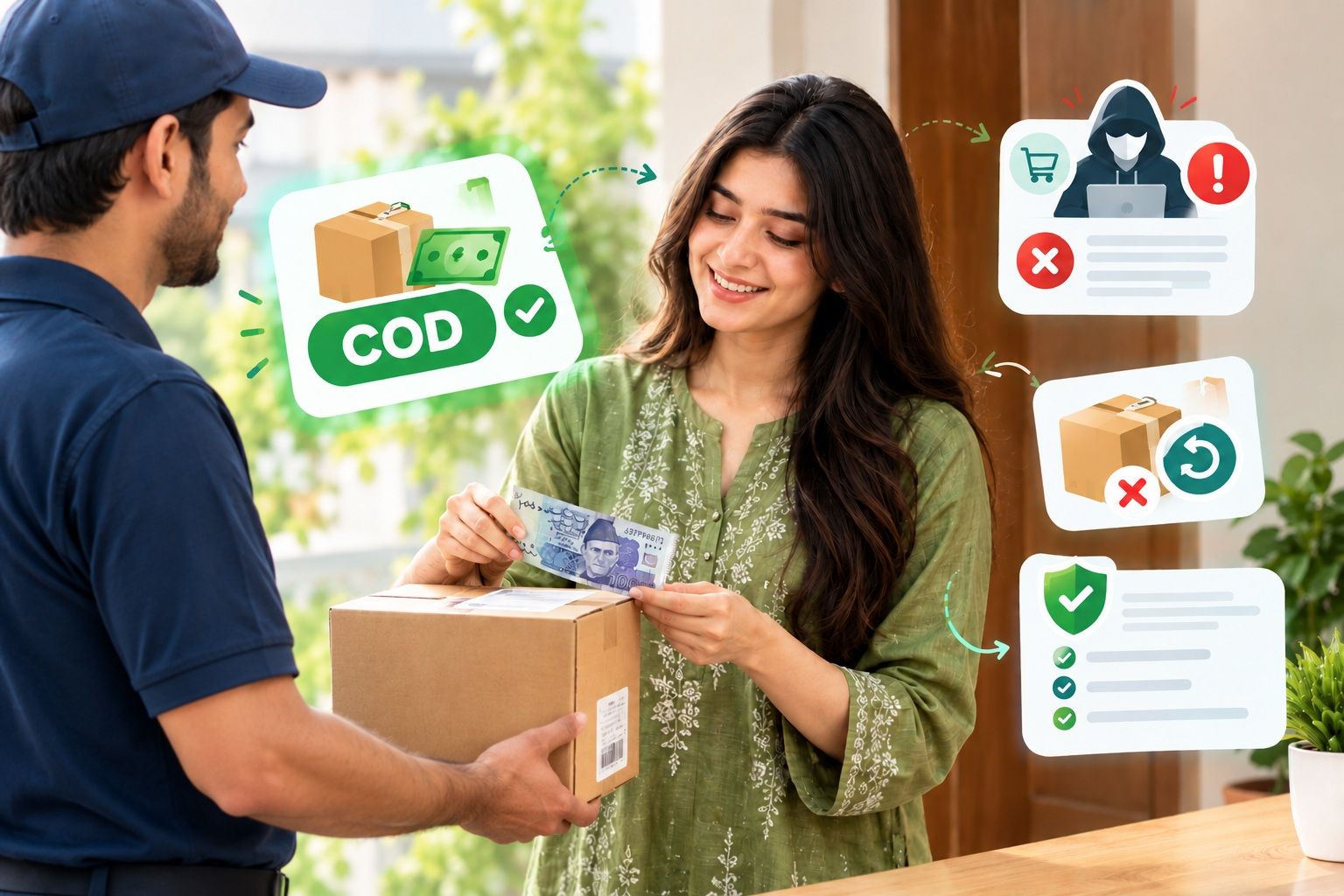
Cash on delivery in Pakistan works like this: the customer orders, you ship through a courier with a COD account, the rider collects cash at the door, and the courier pays you later minus its fee. It is essential for sales here, but fake orders and refused parcels can quietly eat your profit unless you confirm every order and screen risky ones.
How does cash on delivery work in Pakistan?
Cash on delivery means the customer pays the rider in cash when the parcel arrives, and the courier passes that money to you. You never handle the payment yourself. Here is the full cycle for a small shop.
- The customer places an order on your website, WhatsApp or Instagram and chooses COD.
- You confirm the order (more on why this step matters below) and pack it with the courier’s COD label showing the amount to collect.
- The courier picks up from your shop or you drop it at a branch. Your COD account with TCS, Leopards, Trax, M&P, PostEx or another courier is what makes this possible.
- The rider attempts delivery. If the customer pays, the parcel is delivered. If they refuse or cannot be reached, the parcel comes back to you as a return, often called RTO, short for return to origin.
- The courier remits the collected cash to your bank account on its schedule, usually weekly, after deducting delivery charges and a COD handling fee.
Two costs hide in this cycle. Every parcel costs delivery, whether it is accepted or refused. And a refused parcel usually costs a return charge on top, so one failed COD order can cost you two courier fees and a week of tied-up stock.
Why is cash on delivery still so important in Pakistan?
Because most Pakistani buyers still do not trust paying before they see the product, and many do not have a card at all. DHL’s guidance for Pakistani e-commerce sellers cites TGM Research data showing that nearly 70% of online shoppers in Pakistan prefer cash on delivery, and notes that over 30% of the population has no bank account.
Digital payments are growing fast underneath that. The State Bank of Pakistan’s FY25 payment systems review reports that account and wallet-based channels now represent 93% of online payment transactions, which is where JazzCash, EasyPaisa and Raast come in. But that figure counts people who already pay digitally. The customer in Sahiwal buying a kurta from your Instagram page for the first time still wants to see the parcel before handing over Rs 2,500. So COD is not going away. The job is not to avoid it but to run it well.
What are fake COD orders and how do you spot them?
A fake COD order is an order placed with no intention to pay: a prank, a competitor trying to burn your courier budget, a bot filling forms, or a customer who orders from three shops and keeps whichever arrives first. Each one costs you delivery both ways and sometimes damaged stock.
The warning signs are consistent across shops we have spoken to and across courier advice:
- A phone number that never picks up, is switched off, or is not on WhatsApp.
- An incomplete or vague address, such as “near the masjid, Gulshan” with no house number.
- A large first order from a brand-new customer, especially multiple sizes or colours of the same item.
- Several orders from the same number or address in a short time.
- An order placed late at night with a fake-looking name or a name that does not match the number’s WhatsApp profile.
- A customer who refuses to confirm on a call or WhatsApp and says “just send it”.
None of these alone proves an order is fake. Two or three together should stop the parcel until you have spoken to the person.
How do you reduce COD returns?
Confirm every order before dispatch. That single habit cuts returns more than anything else, because most refused parcels come from customers who changed their mind, forgot they ordered, or were never serious. Here are the steps that work in Pakistan, in order of impact.
Confirm on WhatsApp or by call
Before the parcel leaves, send a message or make a call that repeats the product, size, price, delivery charge, address and expected delivery days. Ask for a “yes”. A customer who confirms rarely refuses at the door.
Set delivery expectations clearly
DHL’s guidance notes that unclear delivery timelines are a leading cause of refusals. Say “3 to 5 working days to Lahore” on the product page and in the confirmation. When the rider calls and the customer says “I did not know it would take this long”, that is a return you could have prevented.
Use honest product photos
A parcel that does not match the photo gets refused or returned. No filters, real colours, a photo in hand for size. These returns cost more than fake orders because you also lose the repeat sale.
Screen risky orders
Apply the fake-order checklist above. If the number is off or the customer will not confirm, hold the parcel. You are not losing a sale; you are avoiding two courier fees.
Take a token advance on large or custom orders
For bridal wear, furniture, bulk orders or anything over a few thousand rupees, ask for a small advance through JazzCash or EasyPaisa. Even Rs 500 changes behaviour. Serious buyers pay it without complaint. Time-wasters disappear, which is the point.
Reward prepayment without punishing COD
Offer a small discount or free delivery for JazzCash, EasyPaisa or bank transfer. DHL suggests 5 to 10% works as an incentive. Keep COD available, just make prepaid slightly better, so the share of prepaid orders grows every month.
Keep a returners list
Every shop has a handful of numbers that refuse repeatedly. Note them. Next time they order, ask for full advance payment. Most will not, and you have saved the courier fee.
Choose the courier for returns, not just rates
Ask each courier what happens on a failed delivery: how many attempts, whether they call the customer first, how long the return takes, and what it costs. A courier that makes two attempts and calls the customer will save you more than a courier that is Rs 20 cheaper per parcel.
What does a “normal” COD return rate look like in Pakistan?
Roughly one in five COD parcels comes back. DHL’s Pakistan guidance puts the national average return-to-origin rate for e-commerce at 18 to 20%, and shops selling fashion or cheap impulse items often see worse. A shop that confirms every order, sets clear timelines and screens risky orders can bring that well below the average, and that gap is where the profit is.
Track your own number every month: returned parcels divided by parcels shipped. Above 20%, start with confirmation. Above 30%, something is wrong with photos, delivery times or the courier, and fix that before spending another rupee on ads.
When should you NOT offer cash on delivery?
COD is the right default for most Pakistani shops, but there are cases where it does not make sense, and switching it off for those orders is smart, not unfriendly.
Custom or made-to-order items. If the product is stitched to the customer’s measurements or engraved with a name, a return is a total loss. Take at least half in advance.
Very low-margin products. If your profit per order is less than two courier fees, one refusal wipes out three successful sales. Bundle items, raise the minimum order, or make those products prepaid only.
Fragile or perishable goods. A returned glass item or food parcel often comes back unsellable. Prepaid only, or local rider delivery in your own city.
Repeat refusers and unverifiable addresses. Do not ship COD to a number that has refused twice, or to an address you cannot confirm on a call.
Far-flung areas with weak courier coverage. Some couriers charge more or make only one attempt in remote areas. Check coverage before accepting COD there, or ask for an advance.
There is also a timing question. During shaadi season or Blessed Friday, order volumes triple and confirmation calls fall behind. If you cannot confirm every order in the rush, consider prepaid-only for the busiest days rather than eating the returns in December.
How do you handle a COD return when it happens?
Inspect it the same day, restock it, and record it. Check for damage or tampering before signing the return. Log the customer’s number and the reason the courier gave. At month end, read the pattern: mostly “customer refused” means weak confirmation; mostly “unreachable” means weak screening; mostly “not as described” means your photos are the problem.
Keeping this hisaab is the difference between a shop that fixes returns and a shop that complains about them. Selling online in Pakistan means living with COD, and we are building Dukaandar around how selling actually works here rather than around a card-first market. For the wider picture, our guide on how to sell online in Pakistan in 2026 covers channels, couriers and costs.
Frequently Asked Questions
What is cash on delivery in Pakistan?
Cash on delivery, or COD, is a payment method where the customer pays the courier rider in cash when the parcel arrives, instead of paying online first. The courier then transfers the collected amount to the seller, minus delivery and COD handling charges, usually on a weekly schedule. It is the most common way Pakistanis buy online.
How much does COD cost a seller in Pakistan?
You pay the normal delivery charge plus a COD handling fee, which couriers usually set as a small percentage of the collected amount or a flat fee per parcel. Rates vary by courier, weight and city, so ask for a current rate card. The bigger cost is returns, which charge delivery both ways and tie up stock for a week or more.
How long does it take to get COD money from the courier?
Most Pakistani couriers remit collected cash weekly, and some offer faster cycles for a fee. The timeline runs from delivery date, not order date, so a parcel delivered on Monday may reach your bank the following week. Ask each courier about their remittance schedule before opening an account, because slow remittance strains cash flow during busy seasons.
Is cash on delivery better than online payment?
For winning new customers in Pakistan, COD is better because most buyers will not prepay a shop they do not know. For profit and cash flow, prepaid is better because there are no refusals and no return fees. The practical answer is to offer both, confirm every COD order before shipping, and give a small incentive for prepaid so its share grows over time.
How do I stop fake COD orders?
Confirm every order on WhatsApp or by call before dispatch, and hold any order where the number is off, the address is incomplete, or the customer will not confirm. Watch for large first orders, repeat numbers, and late-night orders with odd names. For high-value items, ask for a small advance through JazzCash or EasyPaisa. Keep a list of numbers that have refused before.
What is a good COD return rate?
Under 10% is good for a small shop that confirms orders; the Pakistan average for e-commerce is around 18 to 20% according to DHL’s guidance for Pakistani sellers. Above 30% signals a process problem, usually unconfirmed orders, unclear delivery times or photos that oversell the product. Track it monthly as returns divided by parcels shipped.
Do couriers in Pakistan charge for returned COD parcels?
Yes, in most cases. The delivery attempt is charged, and a return charge usually applies for bringing the parcel back to you. Some couriers make two delivery attempts and call the customer first, which lowers returns. Ask about attempt policy and return fees before choosing a courier, because these matter more than the headline per-parcel rate.
Conclusion
Cash on delivery is how most of Pakistan buys online, so it is worth running well rather than avoiding. Confirm every order, set honest delivery times, use real photos, screen the risky ones, and take a small advance on big orders. Do that consistently and returns stop being a mystery and become a number you control. If you want a store built for how Pakistani shops sell, COD included, join the Dukaandar waitlist and we will tell you first when it is ready.