To write product descriptions in Urdu and English that sell, lead with what the product is and who it is for, state size, material, colour, price and delivery clearly, write the way your customer talks (Roman Urdu for feeling, English for specs), be honest about what the product is not, and end with how to order. A description’s job is to answer every question that would otherwise become a DM.
Why do product descriptions matter for Pakistani online sellers?
Because a description either answers the customer’s questions or sends them to your inbox, and a customer who has to ask might not wait for the answer. “Size?” “Material kya hai?” “Delivery kitne din?” Each is a question the description could have answered, and each one you answer forty times a day is time not spent on the business.
Descriptions also decide returns. A parcel that does not match what the customer imagined comes back, and with COD return rates around 18 to 20% nationally according to DHL’s guidance for Pakistani sellers, the gap between what was written and what arrived is one of the biggest causes. A description that says “slightly sheer, dupatta recommended” loses a few impulse orders and saves many returns.
There is a Google reason too. On your own website, a description written in your own words is what lets a product page appear when someone in Multan searches for it. Google’s guidance on creating helpful content warns against “simply copying or rewriting” other sources and asks for content that provides “substantial additional value and originality”. A description copied from a supplier’s catalogue helps nobody, including Google.
Should you write product descriptions in Urdu and English, or just one?
Both, in the mix your customers actually speak, which for most Pakistani shops means Roman Urdu for the emotional and conversational parts and English for the technical nouns. Nobody says “farmaish” when they mean order, and nobody says “the fabric drapes beautifully” to their cousin in Faisalabad.
The right balance depends on who buys from you. According to the Digital 2026: Pakistan report from DataReportal, Facebook reached 52.9 million people in Pakistan in late 2025 and Instagram 22.4 million, and the Facebook audience skews heavily toward smaller cities and male buyers. A seller whose customers are mostly on Facebook in Gujranwala should lean toward Roman Urdu. A boutique selling to Instagram buyers in Karachi can write mostly in English with Urdu warmth where it fits.
A practical rule: specs in English, feeling in Urdu, and the two in the same sentence where that is how your customer would say it. “Pure lawn, 3-piece, unstitched. Garmi mein thandak, aur rang dhulne ke baad bhi waisa hi.” That is one description, not two translated versions, and it reads like a person wrote it.
Two mistakes to avoid: translating word for word, when a sentence should switch language mid-thought the way people speak; and writing Urdu script for a Roman-Urdu audience or vice versa. Look at how your customers message you and match that.
What should every product description include?
Seven things, in roughly this order. Most descriptions that fail are missing two or three of them.
- What it is, in one line. Product type, main material, and the one thing that matters most. “Men’s cotton kurta, summer weight, Faisalabad cloth.”
- Who it is for or when it is used. “Daily wear” or “shaadi season” or “gift for Eid”. This is the line that makes a customer think “that’s me”.
- Sizes and measurements, in numbers. Chest, length and sleeve in inches for clothing, dimensions for home items, weight for food. S, M and L alone cause returns.
- Colour and material, honestly. If the photo makes it look brighter than it is, say so. If the fabric is slightly sheer, say so. Honesty here is cheaper than a return.
- What is in the box. Three-piece or two-piece, with or without dupatta, charger included or not. Customers assume the most generous version unless told otherwise.
- Price, delivery charge and delivery time. “Rs 2,450, delivery Rs 200, 3 to 5 working days nationwide” ends the three most common questions before they start.
- How to order and how to pay. “Order on the website or WhatsApp us at this number. COD, JazzCash and EasyPaisa accepted.” Our guide on cash on delivery in Pakistan covers why stating COD up front matters.
Add a care line for clothing (wash cold, do not bleach) and a stated return policy for anything over a couple of thousand rupees. Our guide on returns and refunds without losing money covers what the policy should say.
How do you write product descriptions in Urdu and English that actually sell?
Write it the way you would explain the product to a customer standing in your shop, then cut everything you would not say out loud. Here is the method, with one product carried through.
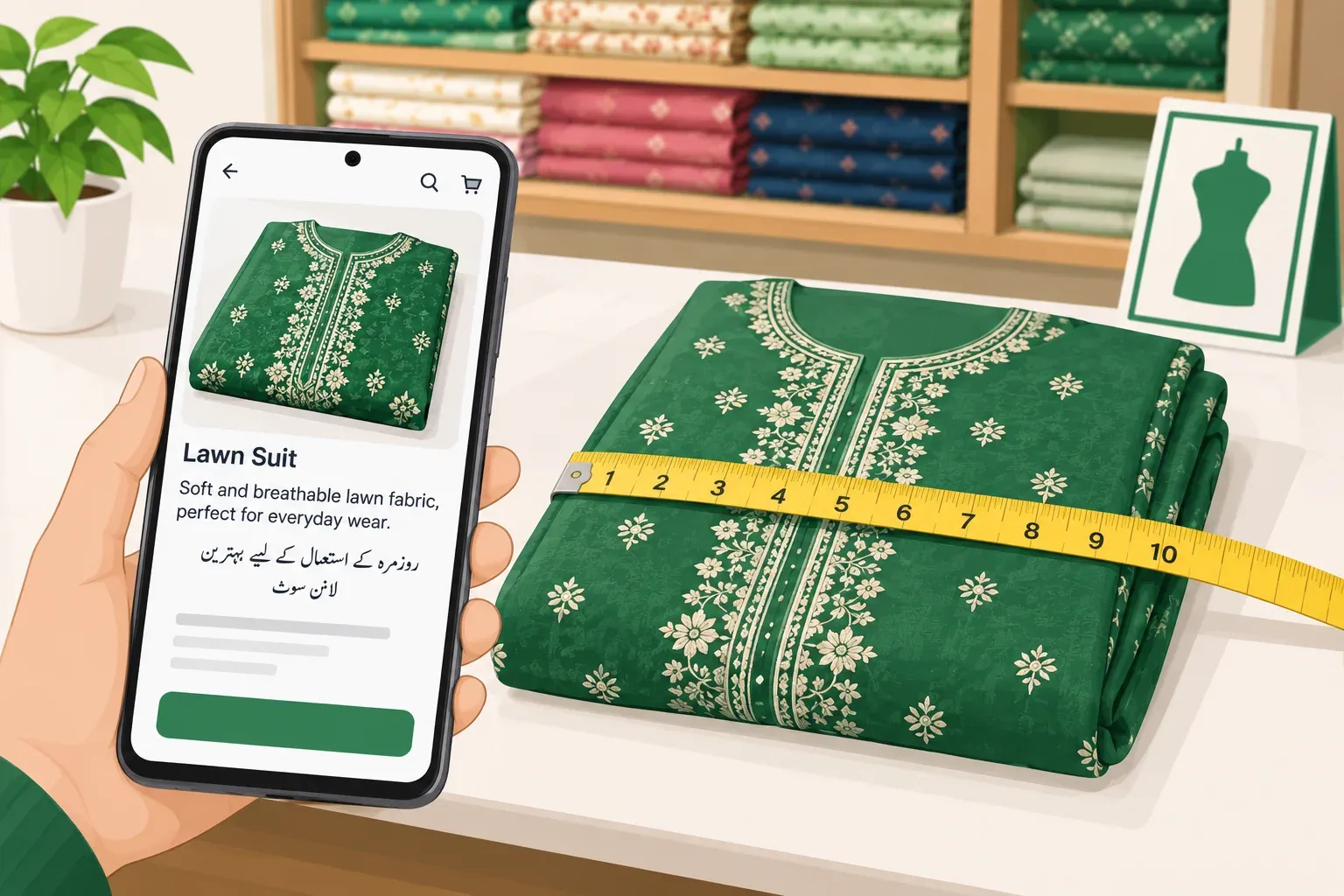
Take a women’s lawn suit. A weak description reads: “Beautiful premium quality lawn suit. Best price. DM for details.” It says nothing a customer can act on and generates three DMs.
A description that sells reads more like this. First line: “3-piece unstitched lawn, printed shirt, plain trouser, chiffon dupatta.” Second: “Halki, garmi ke liye perfect, roz pehnne wali.” Then the specs: shirt 2.5 metres, trouser 2.5 metres, dupatta 2.5 metres, colour as shown in the second photo which is closest to real. Then the honesty line: “Shirt thori si sheer hai, inner recommended.” Then price, delivery and payment: “Rs 2,450, delivery Rs 200, 3 to 5 din. COD, JazzCash, EasyPaisa.” Then the close: “Order karne ke liye website link bio mein, ya WhatsApp karein.”
Every question a customer would ask is answered. The Urdu carries the feeling and the English carries the facts. The honesty line costs a few impulse buyers and saves returns. And there is nothing in it the seller would not say face to face.
Three habits that make this easier at scale: write a template per product category so you fill in details rather than starting blank; write the description before you photograph, so you know which details the photos need to show; and read it aloud once, in the voice of your customer, before you publish.
How should descriptions differ by channel?
The facts stay the same; the length and format change. A customer reads differently on WhatsApp, Instagram, Facebook, Daraz and your own website.
WhatsApp catalogue
Short. Product name, two lines, price, delivery. The customer is already in a chat with you, so anything they cannot see they will ask. Our guide on product photos with just your phone covers the image side, which does more of the work here.
The first line has to work before “more” is tapped. Lead with the hook, feeling or occasion, then the facts, then how to order. Hashtags at the end, not in the sentence. Reels captions can be shorter still; the on-screen text carries the product name and price.
Longer works. Facebook readers read, and buyers in smaller cities want full detail before they comment. Write the complete description in a Roman Urdu-heavy mix, and put the price in the post rather than “inbox for price”.
Daraz
Follow Daraz’s listing format and category requirements, fill every attribute field, and keep the description factual. Marketplace buyers compare on specs and price, so completeness and accuracy matter more than voice. Keep the brand name consistent with your own store so customers can find you by name.
Your own website
The full description, in your own words, with headings for specs, sizing, care and delivery. This is the version Google reads, so it must be original and complete. Include the measurements as text, not only in an image.
When should you NOT write long descriptions?
Length is not the goal; answered questions are.
Simple, standard products, a phone charger, a plain white dupatta, a pack of kitchen sponges, need the facts and the price. Padding them with adjectives wastes the customer’s time and reads as filler.
WhatsApp Status and Stories need almost nothing beyond product, price and how to order; the image carries it.
And do not write what you cannot stand behind. “Export quality” and “premium” mean nothing and invite disappointment. Say what the fabric is and where it is from; that is the claim that holds up when the parcel arrives.
What mistakes make product descriptions fail?
“DM for price.” The customers who will not DM are gone, and the ones who do cost you a conversation per sale. Put the price in the description.
Adjectives instead of facts. “Beautiful, premium, best quality” tells the customer nothing. “Pure cotton, 180 GSM, pre-washed” tells them everything.
No sizes in numbers. S, M and L mean different things in every shop. Inches do not.
Copying the supplier’s text. It is usually wrong for your product, often in bad English, and identical to twenty other listings.
Hiding delivery charges. The customer finds out at checkout or at the door, and either cancels or refuses the parcel.
Overpromising. “Exactly as shown” when the colour is not. The return comes with the courier charge both ways.
Writing in a language your customer does not use. A fully English description for a Facebook audience in a smaller city, or stiff formal Urdu for a Karachi Instagram buyer, reads as not for them.
On your own store, descriptions also do the job of being found. We are building Dukaandar as a Pakistan-made store platform designed around how shops here sell, and a good description is part of what makes any store, ours included, convert. It is still in development.
Frequently Asked Questions
Should I write product descriptions in Urdu or English in Pakistan?
Both, mixed the way your customers speak: English for specs like fabric, size and price, Roman Urdu for feeling, occasion and the conversational lines. Lean more toward Urdu for Facebook buyers in smaller cities and more toward English for Instagram buyers in big cities. Never translate word for word; write one description in the natural mix.
What should a product description include?
What the product is, who it is for, sizes and measurements in numbers, colour and material stated honestly, what is in the box, the price with delivery charge and delivery time, and how to order and pay. Add a care line for clothing and a return policy for higher-priced items. If a customer would ask it, the description should answer it.
How long should a product description be?
As long as it takes to answer every likely question, and no longer. Simple products need two or three lines. Clothing, electronics and anything with sizes or variants need a full description with measurements. On WhatsApp keep it short; on Facebook and your own website write the complete version.
Is Roman Urdu or Urdu script better for online selling?
Match how your customers message you. Most Pakistani buyers type in Roman Urdu on WhatsApp, Facebook and Instagram, so Roman Urdu reaches them in the form they read fastest. Urdu script suits audiences that write to you in script and reads as more formal. Check your own inbox before deciding.
Should I put the price in the description or say “DM for price”?
Always put the price in the description, along with the delivery charge. “DM for price” loses every customer who will not message, costs you a conversation for each one who does, and reads as if the price depends on who is asking. A visible price with delivery included builds the trust that makes a stranger order.
Can I copy product descriptions from my supplier?
No. Supplier text is often inaccurate for your exact product, frequently in poor English, and identical to many other listings, which helps neither customers nor your Google ranking. Google’s helpful content guidance asks for original content that adds value. Use the supplier’s specs as a starting point and write the description in your own words.
How do product descriptions reduce returns?
By closing the gap between what the customer imagined and what arrives. Honest colour notes, measurements in inches, a line about sheerness or weight, and clear delivery times mean fewer parcels refused at the door or sent back. Each prevented return saves courier charges both ways and keeps the customer.
Conclusion
A product description that sells is a conversation with your customer written down: what it is, who it is for, the facts in numbers, the truth about what it is not, the price with delivery, and how to order, in the English-and-Urdu mix your customers actually use. Write it once properly and it answers the questions that would otherwise fill your inbox and the returns that would otherwise fill your courier bill. If you want a store built for Pakistani shops where those descriptions do their work, join the Dukaandar waitlist and we will tell you first when it is ready.