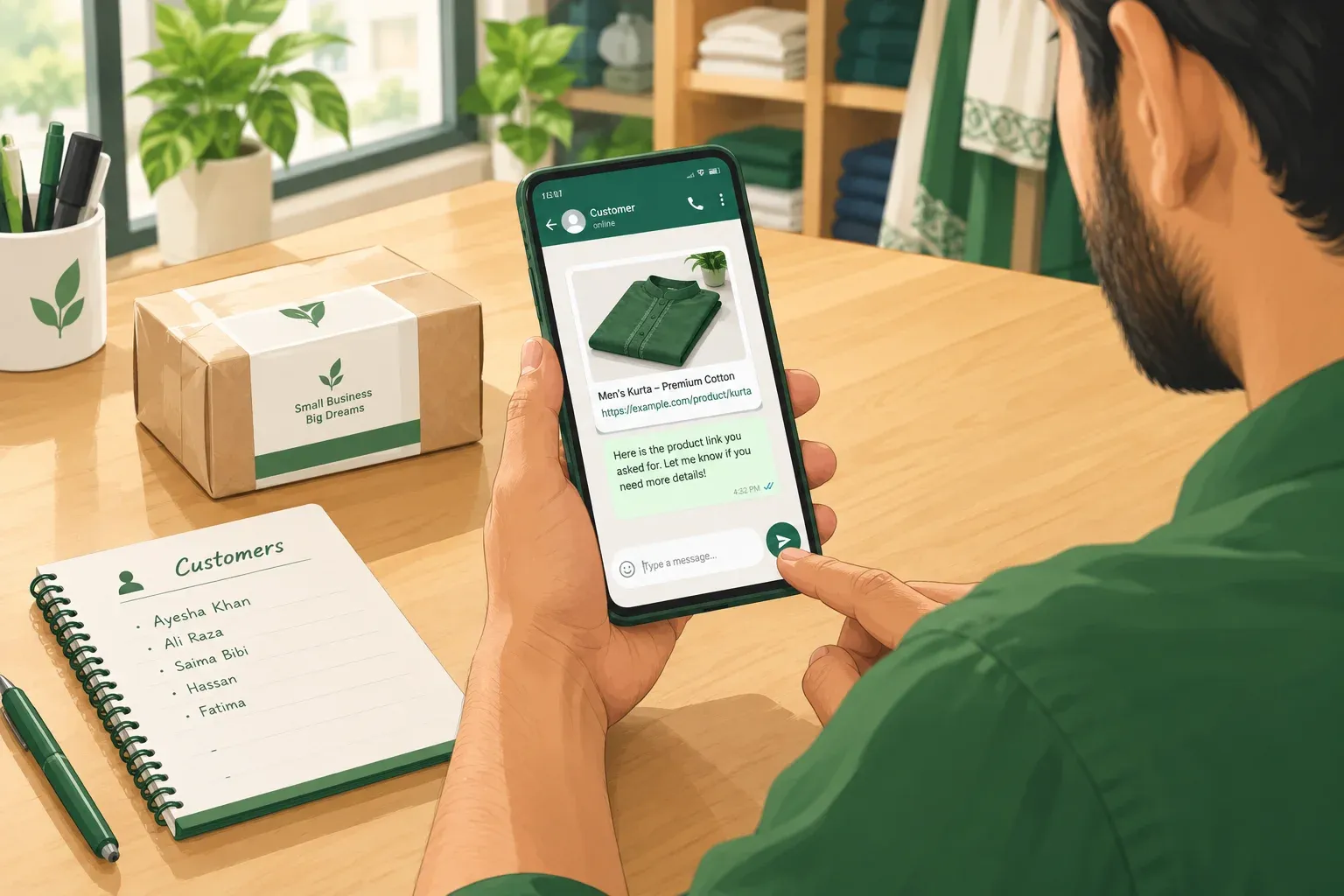
To move customers to your own store, treat Instagram and Daraz differently. Instagram followers are your audience: put the store link everywhere, send product links instead of typing details, and give repeat buyers a reason to order direct. Daraz buyers belong to Daraz, and its terms forbid redirecting them, so you win them through your brand, not through their inbox.
Why move customers to your own store at all?
Because a customer you can reach directly is worth more than a sale you got through someone else’s platform. On Daraz, the buyer, their phone number and their order history belong to Daraz, and every repeat purchase pays commission again. On Instagram, the follower is yours in theory, but the platform decides who sees your posts, and a restricted account takes the whole list with it.
Your own store changes three things. You keep every customer’s number and city. You keep the full margin on repeat orders. And you can message past buyers, with their consent, before shaadi season and Blessed Friday instead of hoping the algorithm shows them your post. The National Retail Federation’s 2025 returns report found 71% of consumers are less likely to shop with a retailer again after a poor experience; the flip side is that a good experience on your own store, with your own name on it, is what makes the second order happen without an ad.
None of this means leaving Daraz or Instagram. Both bring new buyers you could not find alone. The goal is that the second purchase, and every one after it, happens where you keep the customer.
Can you move Daraz customers to your own store?
Not directly, and trying to can get your seller account suspended. Daraz’s terms and conditions state that users must not “lure other users to engage in offline transactions outside of the Daraz Platform” or “redirect a sales transaction to other platforms and/or avenues”, that all messages must go through Daraz’s official channels, and that Daraz “monitors all kinds of buyer-seller communications and is authorized to take action in case of any violations.”
That rules out the shortcuts sellers are tempted by: messaging a Daraz buyer with your WhatsApp number, slipping a “10% off on our website” card into the parcel, or copying buyer numbers from orders into a broadcast list. Any of these is a policy breach, and the downside, losing a channel that brought you customers, is far worse than the upside.
What you can do is build a brand strong enough that Daraz buyers look for you. That means a consistent brand name on your Daraz store, your packaging and your own website, so a customer who liked the product can find you by name on Google or Instagram. It means product quality and packing that make the brand memorable. And it means your own store existing and being easy to find, so that when a Daraz customer searches your brand name, the first result is you.
Read Daraz’s current seller policies yourself before adding anything to a parcel or a message; they change, and this article is a summary, not legal advice.
How do you move Instagram customers to your own store?
Instagram customers are already yours, so here the job is removing friction, not working around rules. The platform has no objection to you sending followers to your website; it gives you a bio link for exactly that.
- Put the store link in your bio, in your Story highlights, and in your WhatsApp Business profile. Every place a customer looks for how to order should answer with the link.
- Stop typing product details into DMs. When someone asks “price?” or “available in large?”, send the product link. The customer sees the price, sizes, delivery charge and COD option, and orders there. You confirm on WhatsApp. This single habit moves most of your sales within a month.
- Post the link, not just the product. Every product post and Reel should say where to order, in the caption and in the Story that reposts it. “Link in bio” works; a direct product link in a Story sticker works better.
- Run any ads to the product page, never to your DMs. An ad that lands on a page with a price and a buy button converts, and you can see which ad produced which order.
- Give existing followers a reason to try the store once. Free delivery on the first website order, a small discount code shared only on Instagram, or early access to new stock on the website a day before it is posted. One good first experience and most of them order there next time.
- Collect WhatsApp consent properly. When a customer orders on the website or confirms on WhatsApp, ask whether they want to hear about new stock and offers. The WhatsApp Business Messaging Policy requires that you have “received opt-in permission from the recipient” before sending messages, and that you respect every request to stop. Keep a list of who said yes.
Our guide on whether you need a website if you already sell on WhatsApp and Instagram covers what the store needs to have in place before you send people there.
What should your own store have before you send customers to it?
A store that is worse than the DM experience sends customers straight back to the DM. Before you move anyone, make sure five things are true.
The store loads fast on a phone on 3G. Most of your customers are on mobile data in cities where coverage is patchy. Compress your photos and test on a cheap phone, not your laptop.
Every product shows its price, sizes, delivery charge and delivery time up front. The reason customers DM is to ask these; if the store does not answer them, they will keep asking.
COD, JazzCash, EasyPaisa and bank transfer are all at checkout. A store that only takes cards is a store most Pakistani customers cannot use.
Orders trigger a WhatsApp or SMS confirmation. Customers who have always ordered by chat need to see that the order was received by a human, not just a website.
Your returns policy is visible and matches what you told them on Instagram. Our guide on returns and refunds without losing money covers what it should say.
How do you keep customers once they have moved?
Keeping a customer costs a fraction of finding one, and most Pakistani small shops never message a past buyer at all. The shops that grow do four simple things.
They message past customers with consent, two or three times a season, not every week. New stock, a shaadi season reminder, a Blessed Friday early-access offer. A broadcast list of people who said yes is the most valuable thing a shop owns.
They make the second order easier than the first. Saved address, one-tap reorder, and a reply to every order within hours.
They remember people. A customer who bought a kurta in lawn season gets a message when the winter collection arrives, in that size.
They handle problems fast and in Urdu. A customer who had a return handled well on your store is more loyal than one who never had a problem.
When should you NOT push customers to your own store?
Sometimes the right move is to leave them where they are, for now.
If your store is not ready, do not send anyone. A slow site with no COD option, no confirmation and no returns policy will cost you customers you already had. Fix the store first.
If Daraz is your main source of new buyers and you cannot afford the risk, stay fully inside its rules and focus on brand, not redirection. The policy is clear and the penalty is your account.
If you have under a few dozen regular customers, the effort of building a store and moving them may be more than the repeat business justifies yet. Grow the following on Instagram and WhatsApp first; our guide on starting an online store in Pakistan with zero investment covers that stage.
And do not push customers who clearly prefer chatting. Some buyers, especially older ones and those in smaller cities, will always order by WhatsApp. Let them. Take their order, enter it in your store yourself so the record exists, and keep the relationship.
How do you measure whether the move is working?
Track three numbers each month: the share of orders placed on your store versus DMs or Daraz, the number of repeat customers who ordered direct, and the size of your consented WhatsApp list. If the store share rises, repeat direct orders rise, and the list grows, the move is working even if total sales look flat for a month. If the store share rises but repeat orders do not, the first experience on the store needs fixing.
Keeping those numbers is easier when orders and customers from every channel land in one place, which is part of why we are building Dukaandar, a Pakistan-made store platform designed around how shops here sell. It is still in development.
Frequently Asked Questions
Can I ask Daraz customers to buy from my website instead?
No. Daraz’s terms prohibit luring users into transactions outside the platform or redirecting a sale elsewhere, require all communication to stay in Daraz’s channels, and state that Daraz monitors buyer-seller messages and can act on violations. Build your brand so customers find you by name instead; read Daraz’s current policy before putting anything in a parcel.
How much does it cost to move customers to my own store?
Moving them costs little beyond the store itself: a link in your bio, product links in DMs, and a one-time incentive such as free delivery on the first website order. The store carries a monthly subscription, in dollars on global platforms and in rupees on Pakistan-built ones, plus a domain. Courier and returns remain the larger ongoing cost.
How long does it take to move Instagram customers to a website?
Most sellers see the majority of regular customers ordering on the store within one to three months of consistently sending product links instead of typing details in DMs. New followers move faster because the link is the first thing they see. Older customers who prefer chatting may never move, and that is fine.
Is it better to sell on Daraz or on my own store?
Both, for different jobs. Daraz brings buyers who are already searching and owns the relationship; your own store keeps the customer, the margin and the data. Use Daraz for reach and your own store for repeat business, and keep the two fully within Daraz’s rules.
Can I message my customers on WhatsApp about new stock?
Only with their consent. WhatsApp’s Business Messaging Policy requires opt-in permission before you message someone, and you must honour any request to stop. Ask at the point of order whether they want updates, keep a list of who said yes, and message a few times a season rather than every week.
Should I offer a discount for ordering on my website?
A one-time incentive such as free delivery on the first website order or early access to new stock works well on Instagram and WhatsApp, where the customers are yours. Do not offer it inside Daraz orders or messages, where redirecting a sale breaches Daraz’s terms.
What if customers keep ordering on WhatsApp anyway?
Let them. Take the order, enter it into your store yourself so the customer record and stock count stay accurate, and confirm as usual. Many Pakistani customers, especially in smaller cities, will always prefer chat. The goal is to own the relationship, not to force a channel.
Conclusion
Instagram customers move to your store when the store is easier than the DM: link everywhere, product links instead of typed details, a reason to try it once, and WhatsApp consent collected properly. Daraz customers cannot be moved and should not be; build a brand they can find by name and stay inside Daraz’s rules. Either way, the point is that the second order lands where you keep the customer. If you want a store built for Pakistani shops to do exactly that, join the Dukaandar waitlist and we will tell you first when it is ready.