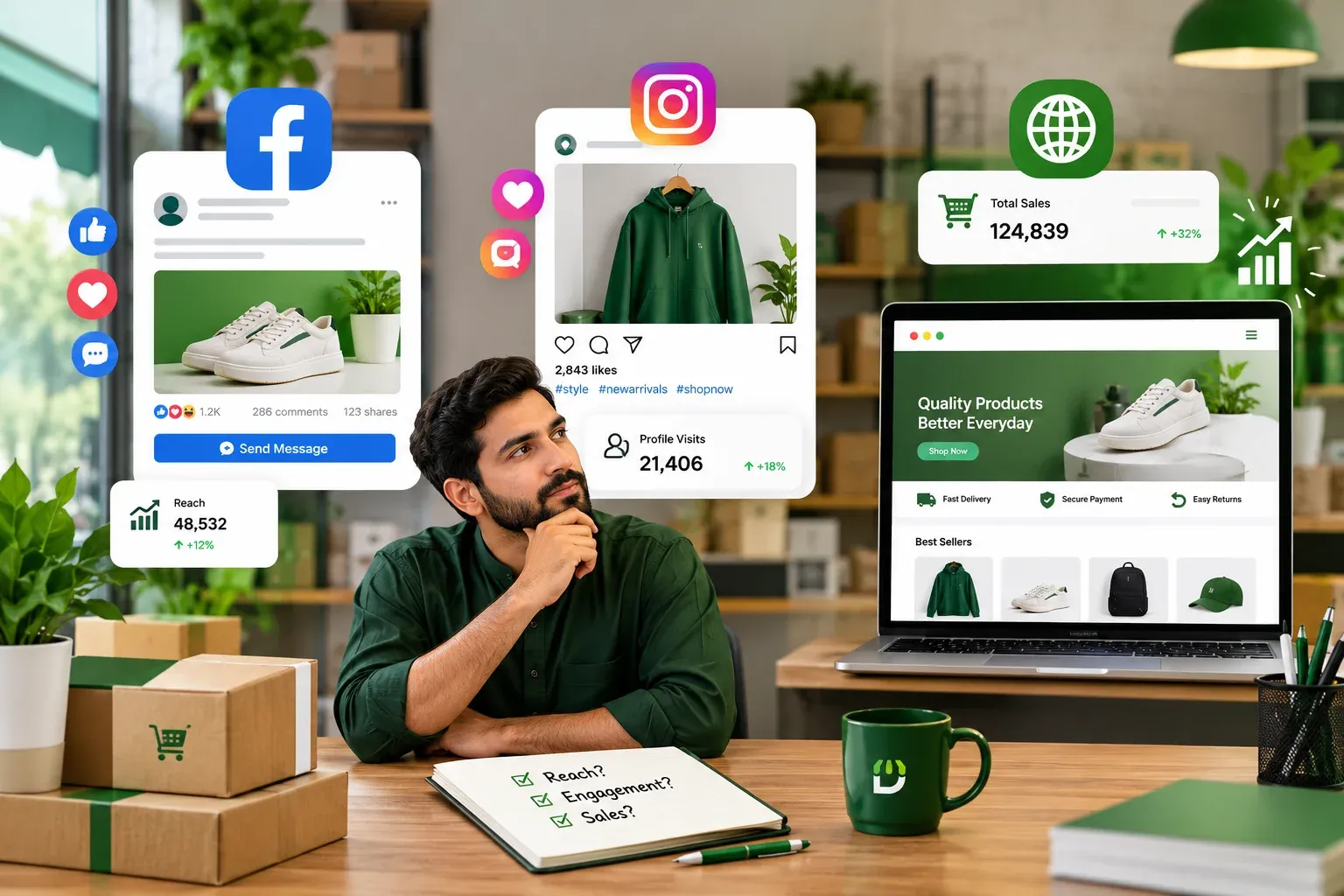
In the Facebook vs Instagram vs website question, Facebook brings the most buyers for most Pakistani shops, especially outside Karachi and Lahore; Instagram brings fewer but higher-spending buyers for fashion, beauty and decor; your own website is where sales close without you in the chat and where you keep the customer. The shops that grow use all three: Facebook and Instagram to find buyers, the website to take the order.
Facebook vs Instagram vs website: which brings the most sales in Pakistan?
Facebook, by reach alone, and the gap is bigger than most urban sellers assume. According to the Digital 2026: Pakistan report from DataReportal, Facebook’s ad reach in Pakistan was 52.9 million people in late 2025 against Instagram’s 22.4 million. That is more than twice the audience, and most of the difference lives in tier-2 and tier-3 cities: Faisalabad, Gujranwala, Sialkot, Multan, Hyderabad, Sukkur.
Reach is not the same as sales, though. Facebook’s adult ad audience in Pakistan is 79.2% male and 19.5% female, while Instagram’s is 63.0% male and 34.9% female, per the same report. If you sell lawn suits, jewellery, makeup or home decor, Instagram’s smaller audience contains a much larger share of the people who actually buy from you. If you sell hardware, mobile accessories, sports goods or anything bought by men in smaller cities, Facebook is where the orders are.
And neither platform closes the sale by itself. Both send a buyer into your DMs, and what happens there decides whether the sale happens. That is the gap a website fills.
What is a Facebook page good for?
A Facebook page is the best channel in Pakistan for reaching buyers outside the big three cities, for older customers, and for selling through groups. It is also the easiest channel to start with and the most forgiving of imperfect photos.
Who you reach on Facebook
Shopkeepers, traders and families in cities where Instagram has barely arrived. Buyers who comment “price?” on a post and expect a reply in the comments, not a DM. Facebook buy-and-sell groups for cities, neighbourhoods and product categories, which are free and often more effective than the page itself.
What sells on Facebook
Practical products with a clear price: mobile accessories, kitchen items, cloth by the metre, sports goods, kids’ items, electronics, anything a man in Gujranwala orders for his shop or his home. Longer captions work here; Facebook readers read.
Where Facebook falls short
Orders arrive as comments and Messenger threads that are easy to lose. Reach for an unpaid page post is low, so you are either posting in groups constantly or paying for ads. And the page is Meta’s, not yours: a restriction pauses your business with no appeal that answers in Urdu.
What is Instagram good for?
Instagram is the best channel in Pakistan for visual products and for urban, younger, more female buyers who spend more per order. It builds a brand in a way Facebook does not, and it is where boutique and D2C businesses in Karachi, Lahore and Islamabad live.
Who you reach on Instagram
A smaller, more affluent audience with a much higher share of women. The report’s figures above tell the story: roughly one in three Instagram users in Pakistan is female, against one in five on Facebook. For fashion, beauty, jewellery, decor and gifting, that is your buyer.
What sells on Instagram
Anything that looks good in a square photo or a fifteen-second Reel. Clothing on a person, not on a hanger. Before-and-after. Unboxing. Reels reach people who do not follow you, which makes Instagram the cheapest way to find new customers for a visual product.
Where Instagram falls short
Instagram sends every buyer to the DM, and a DM is a conversation, not an order. At twenty orders a week this is fine; at eighty it is a full-time job. Instagram also reaches very few buyers in smaller cities, so a Multan seller building only on Instagram is talking to Karachi and Lahore and missing their own neighbours. Our guide to whether you need a website if you already sell on WhatsApp and Instagram covers the moment that breaks.
What does your own website do that Facebook and Instagram cannot?
A website is where the sale actually happens. Facebook and Instagram are where the customer finds you; the website is where they choose a size, enter an address, pick COD or JazzCash, and place a complete order while you are asleep.
Orders that arrive complete
No screenshots, no “address bhejein”, no lost size change. The customer fills in the details, the order appears with everything you need, and you confirm it on WhatsApp before dispatch.
Trust
“Aap ki website hai?” is still the question that separates a real business from a page in many customers’ minds. A domain, which is your store’s web address such as yourshop.pk, answers it before the customer asks.
A customer list you own
Every order gives you a name, phone number and city that belong to you, not to Meta. That list is what you message before shaadi season and Blessed Friday, and it survives any account restriction.
Facebook and Instagram show your products to people scrolling. A website can appear when someone in Peshawar searches “lawn suits online” on Google, which is a buyer who is already looking. Neither social platform gives you that.
Where a website falls short
It brings no traffic by itself. A website with no Facebook page, no Instagram and no Google ranking is an empty shop on a side street. It also costs money, in rupees or in dollars depending on the platform, and it needs maintaining. Our comparison of Shopify vs WooCommerce vs local platforms covers those costs.
Facebook vs Instagram vs website: how should a Pakistani shop combine them?
Use each for what it does best and connect them so a buyer can move from one to the next without friction. Here is the setup most growing shops in Pakistan end up with.
- Facebook page plus two or three local groups for reach in your city and nearby ones. Post practical products with prices, reply to comments, and point serious buyers to WhatsApp or the website.
- Instagram for visual products, Reels for new customers, and Stories for daily presence. Website link in the bio.
- WhatsApp Business for questions and order confirmation. The free WhatsApp Business app gives you a business profile and a product showcase so customers can browse before messaging.
- Your website for the order itself. When a customer asks about a product in a DM or comment, send the product link instead of typing out sizes and prices. They order there; you confirm on WhatsApp.
- Ads, when you are ready, from Facebook or Instagram to a website product page with a price and a buy button, not to a DM queue. This is also how you find out which ad produced which order.
A Faisalabad cloth seller might run Facebook plus website and barely touch Instagram. A Lahore boutique might run Instagram plus website and use Facebook only for ads. The combination depends on who buys from you, which is why the reach and gender figures above matter more than any general rule.
When should you NOT build a website yet?
If you are doing under about twenty orders a week, if you are still testing which products sell, or if you cannot commit to updating stock and answering website orders as fast as WhatsApp, stay on Facebook, Instagram and WhatsApp for now. A neglected website hurts trust more than no website. Our guide on starting an online store in Pakistan with zero investment shows how to do the free version well.
Equally, do not abandon the social channels when the website arrives. Sellers who move everything to a website and stop posting watch sales fall, because the website was never the thing bringing buyers. It was the thing closing them.
Which channel should you start with?
The Facebook vs Instagram vs website answer for a new seller is to start where your customers already are, which for most of Pakistan means Facebook, and for fashion, beauty and decor in big cities means Instagram. Add WhatsApp Business on day one for orders. Add the website when the DMs stop coping.
One honest caveat on the numbers in this article: DataReportal’s figures are advertising reach estimates, not active user counts, and Meta itself warns they are not a proxy for engagement. Treat them as the shape of the audience, not a precise headcount, and test with your own products before committing a budget.
We are building Dukaandar to be the website part of this setup for Pakistani shops: a store that takes the order so that Facebook, Instagram and WhatsApp can do what they are good at. It is still in development.
Frequently Asked Questions
Which is better for selling in Pakistan, Facebook or Instagram?
Facebook for reach and for buyers outside Karachi, Lahore and Islamabad; its ad reach is 52.9 million against Instagram’s 22.4 million. Instagram for visual products and female buyers, who make up about 35% of its audience against 20% on Facebook. Practical goods for smaller cities sell on Facebook; fashion, beauty and decor sell on Instagram.
Do I need a website if I have a Facebook page?
Not to start. A Facebook page plus WhatsApp Business can run a small shop. You need a website when orders get lost in comments and Messenger, when customers ask “website hai?”, when you want to run ads to a page with a buy button, or when you want a customer list that survives an account restriction.
How much does it cost to sell on Facebook or Instagram in Pakistan?
Posting is free. Reach for unpaid posts is limited, so most sellers either post actively in groups or spend on ads. Ad spend is whatever you choose, from a few hundred rupees a day. The hidden cost is time: every sale on social media is a conversation you have to manage until a website takes the order.
Can I sell directly on Instagram in Pakistan?
Instagram shows your products and sends buyers to your DMs or your website link; in-app checkout is not how Pakistani shops sell. In practice an Instagram sale is a DM conversation and a WhatsApp confirmation, or a tap on the product link in your bio or Story that takes the buyer to your website to order.
Is a website better than Instagram for a clothing brand in Pakistan?
They do different jobs. Instagram finds the customer and builds the brand; the website takes the order and keeps the customer’s details. A clothing brand that only has a website struggles to be found; one that only has Instagram drowns in DMs past a few dozen orders a week. Use Instagram to attract and the website to close.
Which social platform works best in smaller cities like Multan or Sukkur?
Facebook, by a wide margin. Instagram’s reach drops sharply outside the big cities, while Facebook pages and local buy-and-sell groups are where shopkeepers and families in tier-2 and tier-3 cities actually browse and buy. A seller in a smaller city should build on Facebook first and treat Instagram as a secondary channel.
How do I move customers from Facebook or Instagram to my website?
Put the website link in your bio, your Facebook page’s shop button and your WhatsApp Business profile. When a buyer asks about a product, send the product link instead of typing details. Run ads to product pages, not to DMs. Over a few months, most repeat customers order on the website and use WhatsApp only for questions.
Conclusion
Facebook brings the buyers, Instagram brings the brand and the higher-spending customer, and your own website brings the completed order and the customer list. In Pakistan, the shops that grow are not choosing one; they are connecting all three so a buyer can go from a post to a paid order without a twenty-message conversation. If you want a store built for that role, made in Pakistan and simpler than Shopify, join the Dukaandar waitlist and we will tell you first when it is ready.